





Think of local SEO marketing as the process of making your business more visible to people searching for what you offer in your local area. It isn’t about competing with large national companies; it’s about making sure that when someone in Leicester needs a plumber, a baker, or a solicitor, your business appears at the top of Google’s search results.
Your Guide to Local Online Visibility
Let’s use an example. Someone is standing by the Clock Tower in Leicester and searches “best coffee near me” on their phone. Local SEO is everything you do to make sure your café is the one that shows up in their Google Maps, not a competitor three streets away. In essence, it’s the digital version of having the best location on the high street.
Instead of casting a wide, expensive net across the entire country, you’re focusing your marketing efforts to attract customers from your specific area. This approach translates directly into real-world results: more phone calls, more website visits, and most importantly, more customers walking through your door.
Why Does This Matter for Your Business?
The way people find local businesses has changed. While word-of-mouth is still important, it now happens online through Google searches and customer reviews. For a small business in Leicestershire, getting this right isn’t just a “nice-to-have” – it’s essential for survival and growth.
Here’s why it’s so important:
- You reach the right people. You connect with potential customers who are actively looking for your exact services, right now, in your area.
- It’s cost-effective. Local SEO is often more affordable than traditional methods like printing flyers or placing an ad in the local paper. The results also build on themselves, creating a long-term asset for your business.
- It builds trust. When your business shows up with good reviews, it sends a powerful signal to both Google and your customers that you are a reputable, trustworthy local expert.
Local SEO is what turns an online search into a real-world sale. It’s about being the best, most convenient answer to a customer’s local problem.
Before we go deeper, let’s compare this modern approach with traditional marketing.
Local SEO vs Traditional Marketing At a Glance
| Feature | Local SEO Marketing | Traditional Local Marketing |
|---|---|---|
| Audience | People actively searching for your service right now. | A broad, general local audience; many won’t be in the market. |
| Reach | Highly targeted to specific towns, postcodes, or service areas. | Limited to circulation area (e.g., newspaper delivery route). |
| Timing | Your business appears at the exact moment of need. | Your ad appears when scheduled, regardless of customer need. |
| Measurement | Clicks, calls, direction requests, and website visits are all trackable. | Difficult to measure direct impact on sales. |
| Lifespan | Long-term; your visibility builds and lasts over time. | Short-term; your ad is gone once the campaign ends. |
| Cost | An ongoing investment that often provides a higher return. | Often requires a significant upfront cost for a brief impact. |
This table highlights the shift. While a flyer might get a glance, a top Google ranking gets you in front of a customer who is ready to take action.
Understanding the Modern Customer Journey
Today’s customer values speed and convenience, and their smartphone is their primary tool. In fact, a reported 96% of people in the UK find local businesses using online searches. What’s more, over 63% of these searches happen on a mobile phone, often while the person is out and about. You can read more about these local search trends on Three Girls Media.
This means your online presence is your new shopfront. It’s the very first impression you’ll make. Getting a handle on the key terms, which we break down in our SEO glossary, is the first step in turning those local searchers into your next loyal customers.
The Three Pillars of Local Search Success
Local SEO can feel a bit overwhelming, so it helps to break it down into three core pillars. Think of them as the foundation, walls, and roof of your digital shop front. When Google decides which local business to show for a search like “best coffee near me,” it’s essentially asking three questions that line up perfectly with these pillars.
Getting these three areas right is often the difference between being the first business a customer calls and not even showing up in the search results. By focusing your efforts here, you can build a strong, visible presence that consistently brings local customers to your business.
Pillar 1: Relevance
First up, we have Relevance. This is all about telling Google, in clear terms, what your business actually does. Are you a plumber in Oadby? A gift shop in Market Harborough? Google needs to understand the specific services and products you offer to match you with someone actively looking for them.
You build relevance by making sure your website content, your service descriptions, and especially your Google Business Profile are accurate, detailed, and clear. If you’re a local bakery, don’t just say you sell “baked goods.” Talk about your sourdough bread, your custom-made celebration cakes, or your vegan pastries. This level of detail helps Google see you as the most suitable answer to a very specific local need.
Pillar 2: Prominence
Next comes Prominence. This is another word for your business’s reputation and authority in the local community. Google’s goal is to recommend businesses that are well-known, active, and trusted. A business with a solid local reputation is always seen as a better choice for its users.
This is where things like customer reviews, mentions in the local press, and links from other respected local websites come into play. A steady stream of positive reviews on your Google Business Profile is probably the most powerful signal of prominence you can get. It’s the digital version of word-of-mouth, telling Google that real people have used your services and had a good experience.
Prominence isn’t just about being known; it’s about being known for doing great work. It’s the proof that backs up the claims you make about your business.
This visual shows how a successful local SEO strategy translates into real-world business results, directly boosting your calls, clicks, and foot traffic.
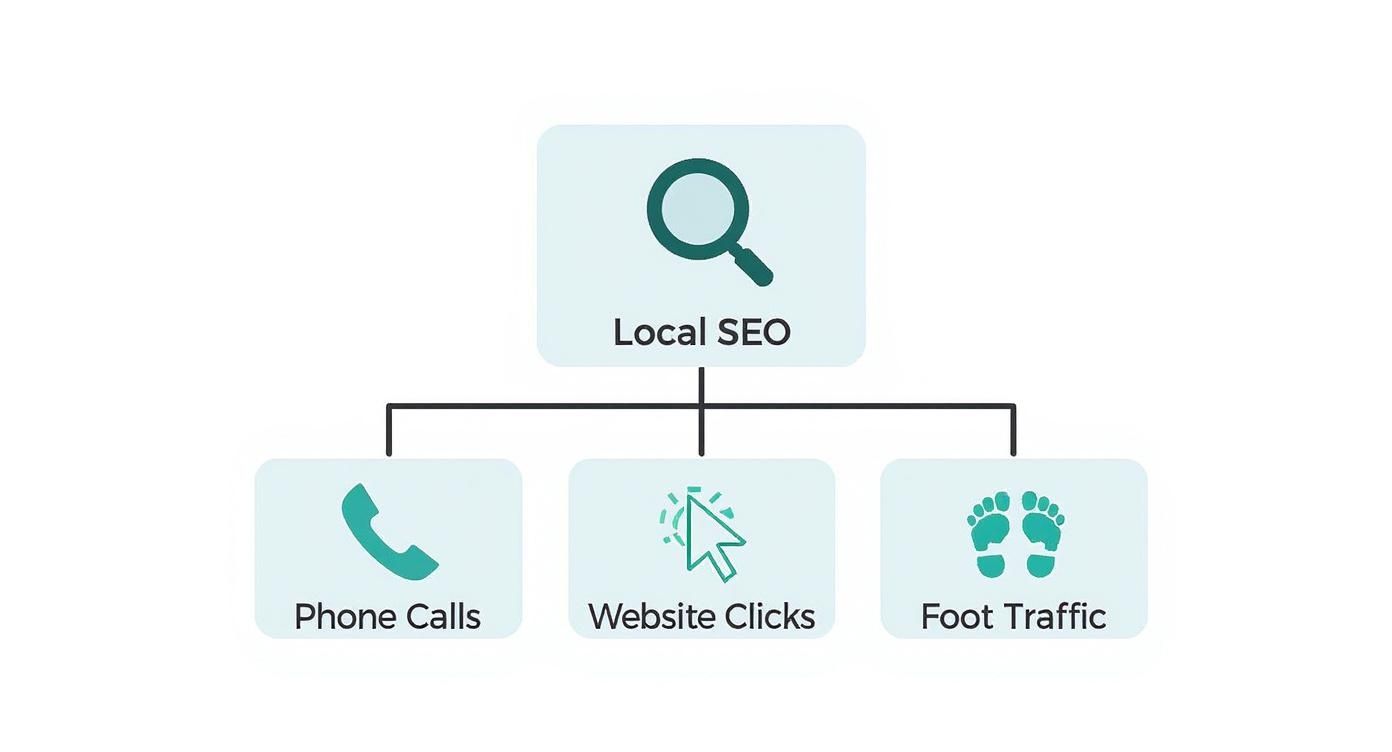
Ultimately, the goal is to drive these three key actions, turning that online visibility into measurable growth for your business.
Pillar 3: Proximity
Finally, there’s Proximity. This one is arguably the most straightforward but also the most critical for local search. It answers a very simple question: how close is your business to the person searching? It should come as no surprise that Google heavily favours results that are physically near the user.
Proximity is mainly determined by the address you’ve listed on your Google Business Profile and the location of the person doing the searching. You can’t move your shop, but you can strengthen your proximity signals. Here’s how:
- Verify your address with Google: This is a non-negotiable first step.
- Create location-specific content: Writing about the towns and neighbourhoods you serve (like Wigston or Hinckley) on your website reinforces your service area.
- Embed a map on your website: This gives Google another clear signal of exactly where you are.
By understanding and actively working on these three pillars—Relevance, Prominence, and Proximity—you create a powerful, balanced local SEO strategy. You’re not just telling Google what you do; you’re proving you’re a trusted local choice and showing exactly where people can find you. This is the foundation you need to master local search and drive consistent growth.
Putting Local SEO Ranking Factors Into Action
Knowing the theory is one thing, but getting results comes from putting it into practice. This is where we shift from the ‘what’ to the ‘how’, breaking down the most important local ranking factors into practical steps for your business. Think of this as your toolkit for getting seen by more local customers.
Each of these elements works together. When they are all aligned, they send strong, consistent signals to Google that your business is a relevant and trustworthy choice for people searching nearby. Getting this right is the key to climbing the local search rankings.
Your Google Business Profile Is Your Digital Shopfront
If there’s one tool you need to master for local SEO, it’s your Google Business Profile (GBP). It’s more than a simple listing; it’s a dynamic profile that acts as the digital front door for your business. For many potential customers, this will be their very first impression of you.
The reality is that almost all local search activity in the UK happens on Google. Its platform has a 93.5% market share, making it the dominant search engine. What’s more, people are relying on Google Maps more than ever to find and choose local businesses, with usage among UK adults jumping from 69% in 2023 to 73% in 2024. You can dig into more stats about UK search behaviour on kentseocompany.co.uk.
To turn your profile into a customer magnet, make sure you focus on these key areas:
- Complete Every Section: Don’t skip anything. Fill out your business name, address, phone number, website, hours, and a detailed description of what you do.
- Choose the Right Categories: Pick a primary category that perfectly describes your main service (e.g., “Plumber”). Then, add secondary categories for everything else you offer (e.g., “Boiler Repair Service”).
- Use All the Features: Don’t just set it and forget it. Regularly share updates and offers using Google Posts, upload high-quality photos of your work and your team, and answer common questions in the Q&A section.
Develop Content That Speaks to Your Community
Your website content has an important job to do. It can’t just describe your services; it needs to establish your business in your local area. This is all about creating content that connects with your community and signals “local expert” to the search engines.
When you’re writing, think from a local perspective. Instead of having one generic page for “electrician services,” create specific pages that mention the towns and neighbourhoods you serve. This is how you tell Google exactly where you operate.
A Leicester-based electrician, for example, could create pages like:
- “Emergency Electrician in Loughborough”
- “House Rewiring Services for Hinckley Homes”
- “EV Charger Installation in Market Harborough”
By creating pages dedicated to specific towns and neighbourhoods, you are building digital signposts that guide both Google and local customers directly to your business.
This approach shows you’re serious about serving the local area, making you a much more relevant result for people searching there. These targeted pages often rank well for specific local queries, bringing in high-quality leads. If you need help creating a content plan, professional SEO services can provide the expertise to get it done right.
The Importance of Consistent NAP Information
One of the most fundamental parts of local SEO is keeping your NAP (Name, Address, Phone number) consistent everywhere online. It’s your business’s digital fingerprint. If that information is different across various websites and directories, it can confuse search engines and reduce their trust in your business.
Inconsistent listings—like having “Ltd” in your name on one site but not another, or an old address on a forgotten directory—send messy, conflicting signals. Google isn’t sure which information is correct, and that uncertainty can harm your chances of showing up in local results.
The goal is simple: make sure your core details are identical everywhere they appear. This includes:
- Your Google Business Profile
- Your website’s footer and contact page
- Your social media profiles (Facebook, LinkedIn, etc.)
- Major online directories (Yell, Thomson Local)
- Niche, industry-specific directories
Encourage Reviews and Engage with Feedback
Customer reviews are today’s word-of-mouth, and they are a major factor in local search rankings. A steady stream of positive reviews tells Google that your business is active, reputable, and that customers are happy. Businesses with more high-quality reviews tend to rank higher than their competitors.
Don’t just wait for reviews to happen. Actively encourage happy customers to leave one. A simple follow-up email after a job is complete or a link to your Google review page on your invoice can work well.
Just as important is how you respond to them—both good and bad. Replying to all feedback shows potential customers you care and are engaged. This interaction is a positive signal to both people and Google.
Build Links from Other Local Businesses
Getting links from other reputable local websites is a powerful way to establish your local authority. When another local business, a nearby charity, or a community organisation links to your website, it’s like them giving you a public vote of confidence.
Think about the connections you already have. Do you sponsor a local football team? Supply another business in town? These are good opportunities to ask for a link from their website. Even getting a mention in a local news article or on a community blog can provide a valuable local backlink, boosting your standing in your specific area.
How Local SEO Differs from National SEO
You might think all SEO is the same, but that’s a common misconception. The truth is, local SEO operates by a different set of rules than its national counterpart.
Think of it like this: national SEO is like trying to get your book into every Waterstones in the country. Local SEO, on the other hand, is about making sure your book is the top recommendation at your town’s independent bookshop. The goals are different, the audience is different, and the tactics must be different too.
Understanding this distinction is the key to creating a strategy that gets you seen by the right people—the ones just around the corner who are ready to buy.
It All Comes Down to Intent and Proximity
The biggest difference is what the searcher wants. Someone typing “buy running trainers online” could be anywhere in the UK. Their intent is broad. But a person searching for “children’s shoe shop Leicester”? That’s someone with a specific, local need, and they’re probably looking to visit a shop very soon.
Local SEO is designed to capture that exact moment. It focuses on signals that national SEO barely considers:
- Geographic Relevance: Your physical address and the areas you serve are central.
- Google Business Profile: This is your digital shopfront on Google itself, often the first thing a local customer sees.
- Local Citations: Consistent mentions of your Name, Address, and Phone number (NAP) across local online directories build trust with Google.
- Local Reviews: What your neighbours and fellow Leicester locals say about you carries immense weight.
National SEO is a broader game. It’s about building authority across the entire country, targeting general keywords, and attracting an audience that isn’t tied to any one place.
A national brand might invest its budget in a feature in a major online magazine. A local Leicestershire business, however, will get far more value by being featured in a “Best of Leicester” guide. The scale is different, but the local impact is significant.
To clarify the differences, let’s put them side-by-side.
Key Differences Between Local and National SEO
This table breaks down how these two approaches diverge in their goals, what Google looks for, and the day-to-day work involved.
| Aspect | Local SEO | National SEO |
|---|---|---|
| Primary Goal | Drive foot traffic, phone calls, and direction requests from a specific service area. | Increase nationwide brand visibility, online sales, and broad organic traffic. |
| Key Ranking Factor | Proximity to the searcher is the most important signal. | Domain authority and the overall strength of the website are critical. |
| Core Tools | Google Business Profile, local directories (citations), and customer reviews. | In-depth content creation, technical website optimisation, and a broad backlink profile. |
| Keyword Focus | Targets “near me” searches and geo-modified terms (e.g., “plumber Market Harborough”). | Targets broad, high-volume keywords (e.g., “how to fix a leaky tap”). |
At the end of the day, a local business spending money on broad, national tactics is like a Kibworth café buying advertising space in Scotland—it’s not an effective use of resources. Focusing squarely on local SEO ensures your effort and budget are aimed directly at the people who can actually become your customers.
How to Measure Your Local SEO Performance
Putting in all this effort is great, but how do you know if it’s working? Measuring your local SEO performance is essential—it’s how you find out what’s effective and prove your investment is paying off.
The key is to focus on the performance indicators (KPIs) that really matter to a local business: the ones that lead to more customers. Think phone calls, booking enquiries, and people visiting your premises. By keeping an eye on the right metrics, you get a clear picture of the tangible impact your strategy is having.
Tracking Your Local Search Rankings
One of the most straightforward ways to gauge progress is to see where you’re showing up in local search results for your most important keywords. What you’re aiming for is a prime spot in the Google ‘Map Pack’—the box with a map and three business listings that appears at the top of the page.
Getting into that pack is a significant achievement. A reported 42% of searchers click on one of those top three results. In fact, businesses that make it into the Map Pack get 126% more traffic than those ranked just a few spots lower. Proximity is the single biggest ranking factor here. You can find more of this data on local SEO effectiveness at searchatlas.com.
So, when you track keywords like “electrician in Hinckley” or “cafe near Leicester Cathedral,” you’re seeing if you’re becoming more visible to the right people in the right place.
Analysing Google Business Profile Insights
Your Google Business Profile is a goldmine of data. The ‘Performance’ section (sometimes called ‘Insights’) gives you a direct look at how real customers are finding and interacting with your listing online.
This data isn’t just a collection of numbers; it’s the story of how local searchers find and engage with your business. It tells you exactly which actions your visibility is driving.
Inside your profile, focus on these three crucial metrics:
- Queries: This shows you the actual search terms people used to find you. It’s useful for understanding customer intent and can give you ideas for your website content.
- Phone Calls: A simple but powerful metric. This tracks how many people clicked the “Call” button straight from your profile. It’s a very direct way to measure return on investment.
- Direction Requests: This tells you how many people asked Google for directions to your business. For any business that relies on foot traffic, this is solid proof your online presence is bringing people through the door.
Measuring Local Organic Traffic and Conversions
Finally, let’s look at your website itself. Using a tool like Google Analytics, you can filter your traffic to see how many visitors are coming from organic search specifically within your service area. This tells you if your localised content and on-page optimisations are effective.
But traffic alone is just a starting point. The real test is what those visitors do once they arrive. That’s where conversion tracking comes in. By setting up simple goals, you can measure how many visitors take a valuable action, such as:
- Filling out a contact form
- Subscribing to your newsletter
- Clicking on your phone number to call
When you track these specific KPIs, you’re no longer guessing. You have clear, evidence-based proof of how your local SEO is contributing to your bottom line, giving you the confidence to invest further in what works.
Your Local SEO Starter Checklist for UK Businesses
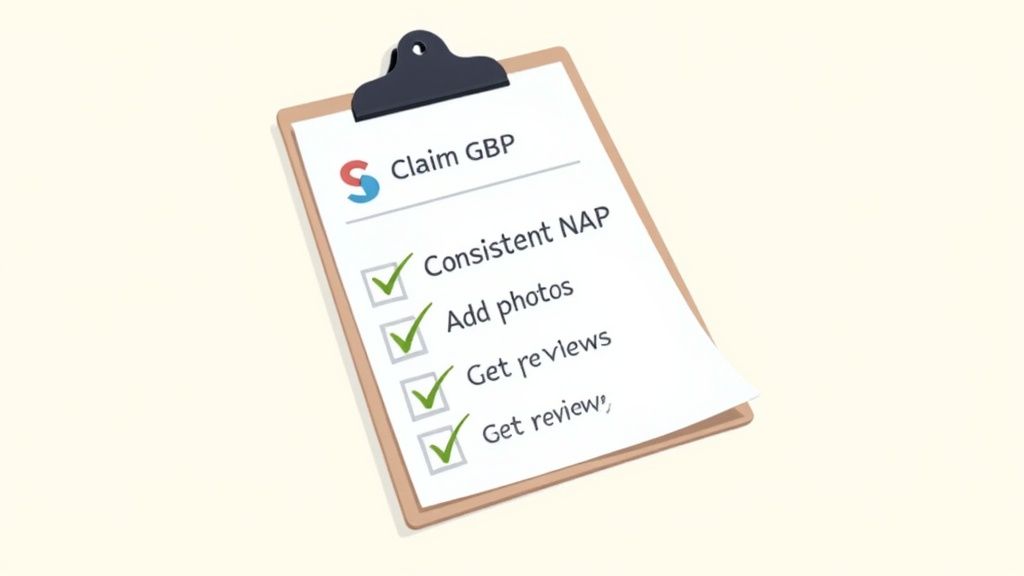
Understanding the theory is one thing, but it’s the action you take that gets results. This checklist offers some initial steps you can take today to get your local visibility moving in the right direction.
These are the essentials that every local UK business needs to have in place. Getting these basics right gives you a solid foundation to build on, making sure you don’t miss out on customers searching for you right now.
Your Foundational Five-Point Checklist
Consider these five tasks the bedrock of your local SEO efforts. Working through them will make your business more visible and credible, both to Google and to your potential customers.
- Claim and Fully Optimise Your Google Business Profile: This is your single most powerful local marketing tool. Go to Google, find your business, and claim the profile. Then, fill out every single section with accurate, detailed information—from opening hours to the specific services you provide.
- Ensure Your NAP is Consistent: Your business Name, Address, and Phone number (NAP) must be identical everywhere online. Double-check your website, your Google Profile, and all your social media accounts. Even small differences can confuse search engines, so consistency is key.
- Upload High-Quality, Recent Photos: A Google Business Profile without good pictures is like a shop with no sign. Add at least ten recent, high-quality images. Show off your premises (inside and out), your team, and examples of your best work. Give people a real sense of what you do.
- Get Your First Few Customer Reviews: Reviews are essential for building trust. Reach out to a few of your recent, happy customers and politely ask if they’d be willing to leave a review on your Google Profile. Getting your first five reviews is a great start.
- Create One Piece of Locally-Focused Content: It’s time to be specific. Write a blog post or add a new page to your website that’s focused on a local area you serve. For example, a page titled “Boiler Repair Services in Loughborough” is far more targeted than a generic “Services” page and has a much better chance of ranking locally.
Putting Your Local Knowledge to Work
Once you’ve got the basics covered, you can start demonstrating your local expertise. This means creating content that speaks directly to the communities you want to do business with. A business that feels genuinely local will nearly always be preferred over a faceless national competitor.
The goal is to become the go-to expert not just in your industry, but in your specific town or county. This connection resonates with local customers and sends powerful relevance signals to Google.
Mentioning specific towns, neighbourhoods, or even local landmarks in your content shows you’re a real part of the community. For businesses in Leicestershire, this hyper-local approach can be very effective. If you’re not sure where to start, our expertise in SEO services in Leicester can help you map out a clear strategy to connect with customers on your doorstep.
Common Questions About Local SEO
As a business owner, you likely have questions about local SEO and what it means for your business. Let’s tackle some of the most common ones with straightforward answers.
How Long Does Local SEO Take To Show Results?
This is a very common question. While some quick fixes, like optimising your Google Business Profile, can provide a boost in a few weeks, effective local SEO is a long-term strategy. Think of it as building a relationship with Google – it takes time to earn trust.
Most businesses start seeing a noticeable increase in calls, website visitors, and local visibility within three to six months of consistent effort. The benefit is that, unlike a paid ad that vanishes when you stop paying, the results of good local SEO compound over time, becoming a solid, long-term asset for your business.
Can I Do Local SEO Myself or Should I Hire an Agency?
You can certainly start the process yourself. The checklist we shared earlier is a good starting point for any business owner. Claiming your Google profile and encouraging customer reviews are powerful first steps you can take today.
However, a comprehensive strategy goes much deeper. It involves keeping up with Google’s algorithm updates, analysing competitors, building valuable local links, and creating content that both Google and customers find useful. This all requires significant time and specialist knowledge.
An agency brings experience and professional tools, which can often get you better results, faster. It comes down to a simple question: is your time better spent working on growing your business or getting involved in the technical details?
Deciding between DIY and hiring an expert is a trade-off between time, budget, and expertise. The right choice is the one that lets you focus on what you’re best at—running your business—while your online presence grows in the background.
How Much Does Local SEO Cost in the UK?
The price can vary significantly. It depends on factors like the competitiveness of your industry and your location. A campaign for a solicitor in Leicester city centre, for instance, will be different from one for a dog groomer in a quiet Leicestershire village.
It’s helpful to think of local SEO as an investment, not a cost. A well-run campaign should deliver a clear return by bringing in more new business than you are spending each month. This turns it into a profitable engine for growth, rather than just another expense.
Is a Website Necessary for Local SEO?
Your Google Business Profile is a powerful tool on its own, but to build authority and succeed in the long run, a professional website is essential. Think of it this way: your Google profile is like the sign above your shop door—it grabs attention and gets people to look.
Your website is the shop itself. It’s where you can provide detailed information, show off your work, build trust with testimonials, and give customers every reason to choose you over the competition. A good website also sends positive signals to Google, which in turn boosts your entire local SEO effort.
Ready to turn local searchers into loyal customers? The team at Little Green Agency has over 20 years of experience helping businesses like yours get seen online. Start with a free, no-obligation audit to see how we can help. Learn more at https://littlegreenagency.co.uk.
Article created using Outrank
