

For small and medium-sized ecommerce businesses, competing online can feel challenging. Large brands with bigger budgets often dominate search results, making it difficult for SMEs to gain the visibility they need. However, effective Search Engine Optimisation (SEO) isn't just for multinational corporations; it's a practical, cost-effective tool that allows smaller businesses to connect with their ideal customers.
With over 20 years of experience helping local businesses thrive, we understand the unique challenges you face. This guide explains ten clear, actionable ecommerce SEO best practices, specifically for platforms like Shopify and WooCommerce. We will provide a direct roadmap covering everything from technical fixes and on-page optimisation to advanced strategies like structured data and internal linking.
The goal is to provide you with practical steps you can implement to improve your rankings, attract more relevant traffic, and grow your online sales. This guide shows how to build a stronger foundation for organic growth with proven strategies that deliver measurable results, helping your business stand out in a crowded online marketplace.
1. Optimise Product Page Title Tags and Meta Descriptions
Your product page's title tag and meta description are often the first interaction a potential customer has with your product in search results. Think of them as your digital shop window. An optimised title tag acts as a clear, concise label, while a compelling meta description encourages the user to click through. This is a fundamental element of any ecommerce SEO best practices strategy because it directly influences both rankings and click-through rates (CTR).
When these elements are written well, they tell search engines what your page is about, helping them rank it for relevant queries. For users, they provide a snapshot of the product, answering initial questions and encouraging a visit to your store over a competitor's. This foundational step is crucial for driving qualified traffic from search engines.
How to Implement This
For every product on your Shopify or WooCommerce store, you should create unique and descriptive metadata. Avoid the default, auto-generated tags, as they are often generic and unhelpful.
- Title Tag Formula: A strong title tag typically follows a pattern:
Primary Keyword (Product Name) | Key Feature (e.g., Colour/Size) | Brand Name. Keep it between 50-60 characters to avoid it being cut short in search results. For example, instead of "Running Shoes," use "Men's Trail Running Shoes – Size 10 UK | BrandX". - Meta Description Focus: Your meta description (150-160 characters) is your sales pitch. It doesn't directly influence rankings but is vital for CTR. Highlight unique selling points (USPs) like "Free UK Delivery," "Eco-Friendly Materials," or "5-Year Guarantee." Ask a question or use a call-to-action to spark interest.
- Avoid Duplication: Do not copy and paste descriptions across similar products. Even slight variations, like a different colour, deserve unique metadata. This prevents search engines from viewing your pages as duplicate content.
This practice is part of a wider on-page SEO strategy. For a more comprehensive look, you can explore our detailed on-page SEO checklist on littlegreenagency.co.uk. By carefully optimising these small but powerful text snippets, you lay a solid foundation for your product pages to be seen and clicked on.
2. Implement Structured Data Markup (Schema.org)
Structured data, often referred to as schema markup, is a standardised format of code you add to your website to help search engines understand your content in greater detail. For an ecommerce site, it's like providing Google with a neatly organised product specification sheet. This code translates your product information—such as price, stock availability, and customer ratings—into a language that search engines can easily process and display as "rich snippets" directly in search results.
Implementing this is a cornerstone of modern ecommerce SEO best practices because it enhances your search listings, making them more visually appealing and informative. When a potential customer sees star ratings, pricing, and stock levels right on the results page, it builds trust and significantly increases the likelihood they will click on your link over a competitor's plain blue link. This leads to a higher click-through rate (CTR) and more qualified traffic.
How to Implement This
While some platforms like Shopify automatically generate basic product schema, you can often enhance it for better results. The goal is to provide as much accurate, relevant product detail as possible using JSON-LD, Google's preferred format.
- Key Schema Properties: For any product page, ensure you include
Product,Offer(for price and currency),AggregateRating(for customer review stars), andavailability(e.g., InStock/OutOfStock). This allows product availability to show directly in search results, a powerful signal for users ready to buy. - Validation is Crucial: Before deploying, always test your code. Use tools like Google's Rich Results Test to validate your markup and ensure it's free of errors. This step prevents issues that could stop your rich snippets from appearing.
- Keep Data Synchronised: Your structured data must perfectly match the information visible to the user on the page. If a price is updated on your product page, the schema markup must be updated simultaneously. Mismatched data can lead to penalties or the loss of rich snippets.
By meticulously marking up your product data, you give search engines the confidence to showcase your products more prominently. This small technical effort can yield significant returns in visibility and traffic quality, making it an essential part of your SEO strategy.
3. Create Unique and Comprehensive Product Descriptions
Beyond metadata, the content of your product page is where you truly sell to both customers and search engines. Unique, detailed product descriptions are critical because they answer user questions, build trust, and provide rich, keyword-relevant text for Google to index. This is a core component of effective ecommerce SEO best practices; it moves beyond simply listing features to telling a story that converts visitors into customers.
Duplicate content is a major issue for ecommerce sites, especially those selling similar products or using supplier-provided descriptions. By writing original copy for every single product, you signal to search engines that your page offers unique value. For customers, a well-crafted description addresses their specific needs and pain points, setting your store apart from competitors who rely on generic text.
How to Implement This
For each product on your Shopify or WooCommerce store, invest the time to create compelling, original content that informs and persuades. Think less like a catalogue entry and more like a helpful sales assistant guiding a customer.
- Balance Benefits and Features: Lead with the benefits. Instead of saying "5000mAh battery" (a feature), say "Enjoy up to 24 hours of use on a single charge" (a benefit). List the technical specifications below in a clear, scannable format, perhaps using bullet points or a table.
- Structure for Readability: Break up text with short paragraphs and descriptive subheadings (like H3s for "Key Features" or "How to Use"). This makes the information easier to digest on all devices.
- Incorporate Keywords Naturally: Weave your primary and secondary keywords into the copy, starting with the primary keyword in the first 100 words. The goal is to write for the user first; the keywords should fit seamlessly into helpful, descriptive sentences, not be forced in.
- Address Customer Questions: Think about what a customer would ask about the product. What problems does it solve? Who is it for? How does it feel or work? Answering these questions proactively builds confidence and can reduce returns.
4. Optimise Product Images with Alt Text and File Names
Product images do more than just showcase your goods; they are powerful SEO assets that can drive traffic from sources like Google Images. Optimising image file names and alt text provides search engines with crucial context about your product, improving your chances of appearing in both standard and image search results. This practice is a key part of any ecommerce SEO best practices framework, enhancing accessibility and adding keyword relevance.
When optimised correctly, your images contribute directly to your page's overall SEO performance. A descriptive file name and alt text tell search engines what the image depicts, helping them to rank it for relevant visual searches. This is also a critical accessibility feature, as it allows screen readers to describe the image to visually impaired users, ensuring a better experience for all customers.
How to Implement This
Every product image on your ecommerce site, from the main shot to the thumbnail, needs to be optimised before and during upload. This process should be a standard part of adding new products to your inventory.
- Descriptive File Names: Before uploading, rename your image files from generic codes like
IMG_9876.JPGto something descriptive and keyword-rich. A good formula isproduct-name-feature-colour.jpg. For example, a file should be namedmens-waxed-cotton-jacket-olive-green.jpginstead of a random number. - Meaningful Alt Text: The alt text should be a concise, natural description of the image, ideally under 125 characters. Think about how you would describe the product to someone who cannot see it. For the jacket example, a good alt text would be: "Man wearing an olive green waxed cotton jacket in a field." This includes the primary keyword and context.
- Image Compression: Large image files are a primary cause of slow page loading speeds, which can harm your rankings. Use tools like TinyPNG or the built-in compression features in Shopify to reduce file sizes without sacrificing visual quality. A fast-loading site is essential for keeping potential customers engaged.
By systematically applying these image optimisation techniques, you open up a significant new channel for organic traffic and improve both the user experience and the technical health of your ecommerce store.
5. Build an Efficient Site Architecture and Internal Linking Strategy
Your website's structure is its digital blueprint. A logical, organised site architecture helps search engines understand the hierarchy of your content, making it easier for them to crawl and index your pages effectively. Paired with a strategic internal linking plan, it guides both users and search engine bots to your most important products, distributing authority throughout your site. This is a core pillar of ecommerce SEO best practices because it enhances user experience and establishes clear topical relevance for your entire product catalogue.
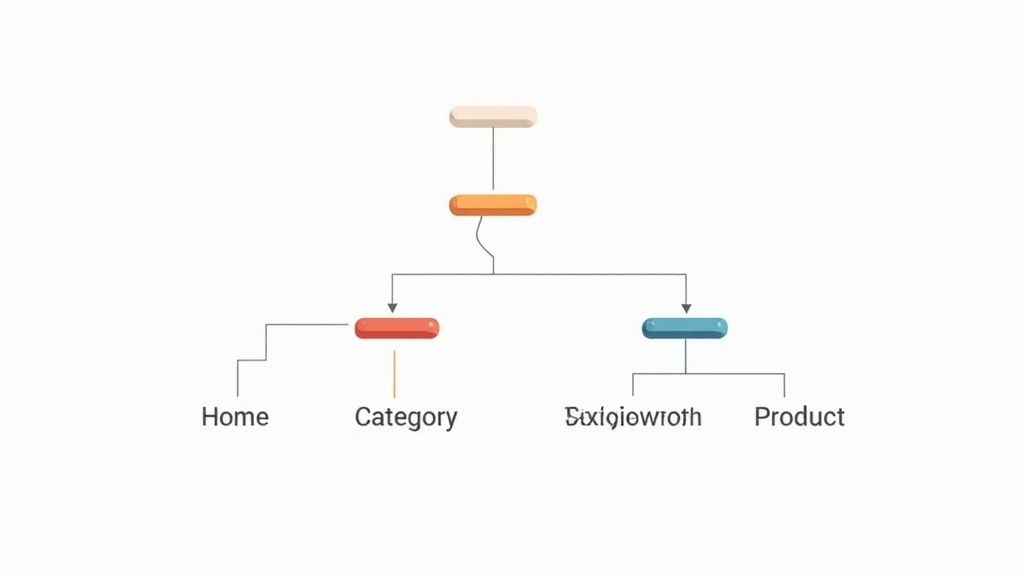
When your site is well-organised, customers can find what they need with minimal clicks, reducing bounce rates. For search engines, this clarity helps them identify your key category and product pages, improving their chances of ranking for relevant search terms. A strong architecture ensures that valuable authority isn't trapped on deep, hard-to-find pages, but is instead spread efficiently to boost the visibility of your priority products.
How to Implement This
For any ecommerce store, the goal is to create a shallow, intuitive structure that prioritises easy navigation. Think of it like a physical retail store: aisles (categories) lead to specific shelves (subcategories), which hold the products.
- Create a Logical Hierarchy: Structure your site logically, typically following a
Homepage > Categories > Subcategories > Productsmodel. Aim to keep any product within 3-4 clicks from the homepage. This "flat" architecture is crucial for efficient search engine crawling. - Use Keyword-Rich Anchor Text: When linking between pages, use descriptive, keyword-rich anchor text instead of generic phrases like "click here." For example, link to your running shoe category using the anchor text "men's trail running shoes" rather than just "shoes."
- Implement Breadcrumbs: Breadcrumb navigation (e.g., Home > Menswear > T-Shirts) should be present on all category and product pages. This improves user experience and provides search engines with another clear signal about your site's structure.
- Link Strategically: From your category pages, link to your most important or best-selling products. On product pages, use "Related Products" or "Customers Also Bought" sections to create contextual links to other relevant items, keeping users engaged and spreading link equity.
By carefully planning your site's architecture and internal links, you build a powerful foundation that supports all other SEO efforts. It’s a fundamental practice that directly impacts how both users and search engines perceive and navigate your online store.
6. Optimise for Mobile-First Indexing and Page Speed
More customers now browse and buy on their phones than on desktops. Google recognises this shift with its mobile-first indexing policy, meaning it primarily uses the mobile version of your content for indexing and ranking. A slow, clunky mobile site not only frustrates potential buyers, leading to lost sales, but also tells search engines your site provides a poor user experience, harming your rankings. This makes mobile optimisation a non-negotiable part of any ecommerce SEO best practices strategy.

A fast, seamless mobile experience directly impacts both your visibility in search results and your conversion rates. When your site loads quickly and is easy to navigate on a small screen, you meet the expectations of both your customers and search engines, creating a powerful foundation for growth.
How to Implement This
Your goal is a fully responsive site that loads in under three seconds on a mobile connection. While platforms like Shopify offer excellent mobile responsiveness out of the box, there are always further optimisations to be made to gain a competitive edge.
- Test and Monitor: Regularly use Google's PageSpeed Insights to test your site's performance and understand its Core Web Vitals. This free tool provides actionable recommendations to improve speed on both mobile and desktop.
- Optimise Visuals: Compress images specifically for mobile displays to reduce file size without sacrificing quality. Implement "lazy loading" so that images and videos below the fold only load as the user scrolls down to them, speeding up the initial page load.
- Streamline Code and Assets: Minimise and combine CSS and JavaScript files to reduce the number of requests the browser has to make. Utilise a Content Delivery Network (CDN) to store copies of your site's assets on servers closer to your users, drastically reducing load times.
- Focus on Mobile UX: Ensure your mobile checkout process is simple, with minimal steps and large, easy-to-tap buttons. Test your site on a range of real devices, not just emulators, to catch any usability issues that could lead to cart abandonment.
7. Implement Comprehensive Keyword Research for Product Categories
Effective keyword research is the blueprint for your entire ecommerce SEO strategy. It’s the process of discovering the specific words and phrases your potential customers type into search engines when looking for products like yours. For an ecommerce store, this goes beyond just product names; it's about understanding customer intent and targeting entire categories of products to attract shoppers at various stages of their buying journey. This is a foundational ecommerce SEO best practice that informs content creation, site architecture, and on-page optimisation.
By conducting thorough research, you move from guesswork to a data-driven approach. You can identify high-intent search terms that signal a user is ready to buy, uncover low-competition opportunities your competitors have missed, and understand the language your customers actually use. This ensures the traffic you attract is not just high in volume but also highly relevant, leading to better engagement and more sales for your store.
How to Implement This
The goal is to build a comprehensive map of keywords for each of your main product categories. This involves using SEO tools to analyse search volume, competition, and related terms, forming the basis of your content and optimisation efforts.
- Focus on Search Intent: Don't just look at volume. Analyse the intent behind a keyword. Is the user looking to buy ("buy black leather boots"), learn ("best boots for walking"), or compare ("BrandX vs BrandY boots")? Match your category page content to this intent.
- Target Long-Tail Keywords: These are longer, more specific phrases (e.g., "men's waterproof hiking boots size 10 UK"). While they have lower search volume individually, they often have higher conversion rates because the user's intent is much clearer.
- Analyse Competitor Keywords: Use tools to see which keywords your direct competitors are ranking for. This can reveal gaps in your own strategy and highlight valuable terms you may have overlooked. Look for keywords where they rank, but their page isn't perfectly optimised; this is your opportunity.
- Create Keyword Clusters: Group related keywords into "clusters" or topic groups. For a "women's dresses" category, you might have clusters for "summer dresses," "party dresses," and "formal work dresses." This helps you build out comprehensive category pages that answer multiple related queries.
8. Create and Submit XML Sitemaps and Manage Crawl Budget
An XML sitemap acts as a roadmap for search engines, providing them with a clear and organised list of all the important pages on your ecommerce website. Think of it as handing Google a directory to your store, ensuring it doesn’t miss any valuable product or category pages. This is a critical component of any ecommerce SEO best practices strategy, as it directly influences how efficiently and completely search engines discover and index your content.
For large online stores with thousands of products and frequent inventory changes, managing how search engines crawl your site is vital. A well-structured sitemap helps prioritise your most important pages, ensuring that Google’s resources (its "crawl budget") are spent on indexing pages that generate revenue, rather than on low-value pages like filtered search results. This prevents indexing delays and ensures your new products get seen quickly.
How to Implement This
Most modern ecommerce platforms like Shopify and WooCommerce automatically generate an XML sitemap for you. However, you need to ensure it's structured correctly and submitted to search engines to be effective.
- Structure Your Sitemaps: For large stores, break your sitemap into smaller, more manageable files. For instance, create separate sitemaps for products, categories, blog posts, and images. You can then list these individual sitemaps in a single sitemap index file. This approach improves crawl efficiency.
- Keep Sitemaps Updated: Ensure your sitemap dynamically updates whenever you add, remove, or change a product. This signals to search engines that there is fresh content to crawl. Include the
<lastmod>tag to indicate when a page was last updated, helping Google prioritise its crawling schedule. - Submit to Search Engines: The most crucial step is to submit your sitemap URL (e.g.,
yourstore.co.uk/sitemap.xml) to Google Search Console and Bing Webmaster Tools. This officially tells them where to find your roadmap. - Monitor Your Crawl Stats: Regularly check the "Crawl Stats" report in Google Search Console. This will show you how Google is interacting with your site and can highlight if your crawl budget is being wasted on unimportant pages.
By effectively managing your sitemaps and crawl budget, you guide search engines to your most valuable content, leading to faster indexing and better visibility. To get started with submitting your sitemap and monitoring its performance, you can explore our guide on how to use Google Search Console on littlegreenagency.co.uk.
9. Build High-Quality Backlinks and Authority Through Content Marketing
While on-page optimisations are crucial, your store's authority in the eyes of search engines is largely built off-page through backlinks. High-quality backlinks from reputable websites act as votes of confidence, telling Google that your content is trustworthy and valuable. This is a core pillar of any ecommerce SEO best practices strategy because it elevates your entire domain's authority, helping all your product and category pages rank higher.
A strong backlink profile doesn't just happen; it's earned through a strategic content marketing approach. By creating genuinely useful resources that solve customer problems, you create assets that other websites naturally want to link to. Think beyond just selling products and focus on becoming an authoritative resource in your niche. This top-of-funnel content attracts potential customers early in their buying journey, building brand recognition and trust long before they are ready to purchase.
How to Implement This
Instead of focusing solely on transactional product pages, develop a content strategy that creates link-worthy assets. This means creating content that provides value far beyond a simple product description.
- Create Comprehensive Buying Guides: For your top product categories, develop in-depth guides that help customers make informed decisions. For example, a retailer selling cameras could create a "Beginner's Guide to Choosing Your First DSLR" that compares models, explains features, and offers tips. This is far more linkable than a standard product page.
- Develop Resource Pages: Publish original research, industry statistics, or "how-to" guides that address common questions related to your products. A furniture store could create a guide on "How to Style a Small Living Room," which bloggers and interior design sites would be likely to reference and link to.
- Promote Your Content: Creating great content is only half the battle. You must actively promote it through social media channels, email newsletters, and outreach to relevant bloggers, journalists, and industry publications. Building relationships is key to earning valuable links.
- Utilise Visuals: Create shareable infographics or high-quality videos that summarise complex information. These are highly shareable and often get embedded in other websites, generating a natural backlink to your store as the source.
This practice shifts the focus from directly selling to helping, which in turn builds the authority needed to improve rankings across your entire site. To understand the fundamentals of this process, you can explore our guide on what link building is in SEO on littlegreenagency.co.uk. By investing in content that serves your audience, you create a sustainable engine for acquiring powerful backlinks.
10. Monitor, Test, and Optimise Using Data
SEO is not a one-time task; it's an ongoing process of refinement based on real-world data. Continuous optimisation involves using analytics tools to monitor your performance, testing changes to see what works best, and making incremental improvements. This data-driven approach is a cornerstone of effective ecommerce SEO best practices because it removes guesswork, allowing you to focus your efforts on strategies that genuinely drive traffic, rankings, and sales.
By consistently analysing how users and search engines interact with your site, you can identify underperforming pages, discover new keyword opportunities, and understand which changes positively impact your bottom line. This cycle of monitoring, testing, and optimising ensures your SEO strategy evolves and stays ahead of competitors.
How to Implement This
Start by setting up the essential free tools from Google for your Shopify or WooCommerce store. A regular reporting rhythm is key to turning data into actionable insights rather than letting it become overwhelming.
- Set Up Foundational Tools: Ensure Google Analytics and Google Search Console are correctly installed. Search Console is vital for tracking impressions, click-through rates (CTR), and technical issues, while Analytics provides insight into user behaviour and conversion rates.
- Establish a Monitoring Cadence: Create a simple routine. For example, check your priority keyword rankings weekly. Review your top-performing and underperforming pages monthly in Search Console to spot opportunities for improvement.
- A/B Test Key Elements: Don't just make changes; test them. Start with your meta descriptions. Create two different versions for a high-traffic product page and run them for 3-4 weeks to see which one achieves a better CTR. You can then apply the winning formula to other pages.
- Analyse and Act: Use data to answer specific questions. If a category page has high traffic but a low conversion rate, use tools like heatmaps to see where users are dropping off. If a blog post is getting impressions but few clicks, test a more compelling title tag.
By embedding this continuous improvement loop into your marketing activities, you transform your SEO from a static checklist into a dynamic, results-focused strategy. This is how you achieve sustainable growth and a real return on your investment.
10-Point eCommerce SEO Best Practices Comparison
| Strategy | Implementation Complexity 🔄 | Resource Requirements ⚡ | Expected Outcomes 📊 | Ideal Use Cases 💡 | Key Advantages ⭐ |
|---|---|---|---|---|---|
| Optimizing Product Page Title Tags and Meta Descriptions | Low — content edits; scalable but needs maintenance | Low — content editors + basic SEO tools | Faster CTR lift; modest relevance gains | Broad catalogs; promo pages; quick wins | ⭐ High ROI, low cost, easy to A/B test |
| Implementing Structured Data Markup (Schema.org) | Medium — JSON-LD coding and validation | Medium — developer support + testing tools | Rich snippets (ratings, price); ↑ CTR ~20–30% | Product pages with reviews/pricing; marketplaces | ⭐ Improves SERP appearance and data accuracy |
| Creating Unique and Comprehensive Product Descriptions | Medium–High — original copy at scale | Medium–High — writers + editorial workflow | Better long-tail rankings; ↑ engagement & conversions | Differentiating SKUs; high-consideration products | ⭐ Reduces duplicates; supports featured snippets |
| Optimizing Product Images with Alt Text and File Names | Low–Medium — systematic updates across catalog | Low — content editors + image tools (compression) | Better image search traffic; improved accessibility | Visual-heavy products; social/image-driven traffic | ⭐ Boosts image SEO and accessibility |
| Building Efficient Site Architecture & Internal Linking | High — planning, possible URL restructuring | Medium–High — dev + SEO architects; ongoing upkeep | Improved crawlability; distributed authority; rankings | Large catalogs; sites needing taxonomy overhaul | ⭐ Enhances topical relevance and navigation |
| Optimizing for Mobile-First Indexing & Page Speed | High — technical performance work | High — developers, performance tools, CDN | Direct ranking impact; ↑ mobile conversions; lower bounce | Mobile-first stores; competitive markets | ⭐ Major ranking factor; better UX & conversions |
| Implementing Comprehensive Keyword Research for Categories | Medium — research and clustering workflows | Medium — paid tools (Semrush/Ahrefs) + analyst time | Targeted traffic; content strategy; higher conversion intent | Launching categories; content & PPC planning | ⭐ Identifies high-intent, low-competition opportunities |
| Creating & Submitting XML Sitemaps and Managing Crawl Budget | Medium — generate and maintain sitemaps | Medium — dev support + monitoring tools | Faster discovery/indexing; efficient crawl for large sites | Large, frequently changing catalogs | ⭐ Improves indexing speed and crawl efficiency |
| Building High-Quality Backlinks via Content Marketing | High — content creation + outreach | High — content team, PR/outreach, promotion budget | Increased domain authority; referral traffic; long-term rankings | Brand building; highly competitive niches | ⭐ Strong long-term authority and visibility |
| Monitoring, Testing & Continuous Optimization Using Data | Medium — ongoing tests and analysis | Medium — analytics/CRO tools + analysts | Incremental gains; quick-win identification; issue detection | Sites with steady traffic for valid tests | ⭐ Data-driven improvements; faster detection of problems |
Making SEO a Core Part of Your Growth Strategy
Navigating ecommerce SEO can feel like a large task, but success isn't about doing everything at once. It's about systematically implementing proven strategies that build upon each other, creating a powerful and sustainable engine for organic growth. From the foundational elements of site architecture and mobile-first optimisation to the granular details of product page titles, structured data, and unique descriptions, each practice contributes to a greater whole. It's about building a user-centric experience that search engines recognise and reward.
The points covered here are the critical pillars of modern ecommerce SEO. Optimising your images, managing your crawl budget with XML sitemaps, and performing deep keyword research for category pages are not isolated tasks. Instead, they are interconnected components of a holistic strategy. A well-structured internal linking plan, for instance, not only improves user navigation but also distributes authority from your high-quality backlinks, amplifying the impact of your content marketing efforts. Mastering these ecommerce seo best practices is what separates thriving online stores from those that remain invisible.
From Theory to Tangible Results: Your Actionable Next Steps
The key to turning this knowledge into measurable success is consistent, focused action. It's easy to feel overwhelmed, but the most effective approach is to prioritise and execute methodically. Don't try to overhaul everything in a single week. Instead, create a roadmap based on the insights from this article.
Here are your immediate, actionable next steps to get started:
- Conduct a Technical Mini-Audit: Start with the basics. Use a tool like Google's PageSpeed Insights to check your site speed and mobile-friendliness. Crawl your site to identify any glaring errors, broken links, or duplicate content that could be hindering your performance right now.
- Prioritise Your Top 10 Products: You don't need to rewrite every product description tomorrow. Select your top-selling or highest-margin products and apply the on-page optimisation techniques we discussed. Refine their title tags, write compelling meta descriptions, add unique, benefit-led content, and implement product schema. This focused effort will deliver the quickest wins.
- Review Your Internal Linking: Examine your key category pages. Are they well-supported with internal links from relevant blog posts and product pages? Identifying and fixing these internal linking gaps is a low-effort, high-impact task you can begin immediately.
- Establish a Monitoring Baseline: Set up proper tracking in Google Analytics 4 and Google Search Console if you haven't already. You cannot improve what you do not measure. Understanding your current organic traffic, keyword rankings, and conversion rates is essential for gauging the success of your future efforts.
For many business owners, the primary challenge isn't understanding what to do, but finding the time and technical expertise to do it effectively. Implementing these ecommerce seo best practices consistently is a significant commitment. Yet, it is this very consistency that compounds over time, building your site's authority and creating a moat against competitors. By integrating SEO into the core of your business operations, you shift from short-term tactics to a long-term strategy that delivers predictable, profitable, and sustainable organic traffic. This is your pathway to scaling your business online.
Ready to transform these best practices into real-world results for your business? At Little Green Agency, we specialise in helping local SMEs harness the power of SEO to drive meaningful growth. We offer transparent, contract-free expertise to help you navigate the complexities of ecommerce SEO and achieve your goals. You can read more about my ecommerce SEO services and how I work.






Leave a Reply