




Trying to improve your Google rankings can feel complex, but the core idea is straightforward. It comes down to understanding what your customers are searching for, creating content that answers their questions, and ensuring your website is technically sound for search engines to read.
There are no secret tricks or overnight results. Improving your business's visibility on Google is a long-term process that requires consistent, focused effort.
Why Your Business Is Invisible on Google and How to Fix It

It can be frustrating to search for your services and see competitors on the first page while your own website is difficult to find. The good news is that climbing the rankings is a methodical process, not a mysterious art.
Modern SEO is not about trying to game the system. It's about demonstrating your expertise and delivering genuine value to your audience. To achieve this, we will focus on three key areas:
- Technical Health: Is your website built in a way that Google can easily understand?
- Content Relevance: Does your website content answer the questions your potential customers are asking?
- Local Authority: Is your business seen as a trusted and relevant choice in your local area?
Setting the Right Foundation
Before addressing content and keywords, it's important to review your website's technical structure. This is the foundation for all other SEO efforts, and if it's not solid, your ranking potential will be limited.
Elements like a mobile-friendly design and fast loading speeds are no longer optional extras; Google considers them essential.
The top result on Google in the UK gets an average click-through rate of 27.6%. You could be missing out on a significant portion of potential customers if your website's technical setup is not right.
For many UK small and medium-sized businesses, improving rankings starts here. Even the best content can be held back by poor site architecture or a frustrating mobile experience. A recent Google core update emphasised this, with UK sites optimised for mobile seeing a noticeable improvement in visibility. You can find more UK search statistics on SQ Magazine if you're interested.
This guide is designed to be a practical roadmap with actionable steps. We’ll start with on-page SEO essentials and then move on to the local tactics that are critical for UK businesses looking to connect with customers online.
Your First Step: A Practical DIY SEO Audit
Before you can improve your Google rankings, you need to understand your starting point. Think of it as checking under the bonnet before a long journey. An SEO audit might sound technical, but you can find a lot of useful information on your own without expensive tools.
The goal here is to identify the "low-hanging fruit" – the quick fixes that can provide a noticeable boost without requiring a significant investment of time or money. This initial check will give you a simple to-do list.
Start with the User Experience Basics
Google’s primary goal is to provide its users with the best possible answers. This means it favours websites that are easy to use. Two of the most important factors are mobile-friendliness and page loading speed.
With over half of all web traffic now coming from mobile phones, your site must function well on a smaller screen. If it’s difficult to navigate on a phone, you’re already at a disadvantage.
Google provides free tools to check this:
- Mobile-Friendly Test: Enter your URL, and it will tell you if Google considers your pages mobile-friendly.
- PageSpeed Insights: This tool analyses your site's loading speed on both mobile and desktop and provides suggestions for improvement.
A slow website can cause potential customers to leave and signals to Google that the user experience is poor, which can negatively affect your rankings.
Check Your On-Page SEO Essentials
Next, let's look at basic on-page elements. These are the signals that tell Google what each page of your site is about. Focus on your most important pages first, such as your homepage and main service pages.
On each of these key pages, check two things:
- Title Tags: This is the text in the browser tab and the main blue link in search results. It should be clear, unique, and contain the main keyword for that page.
- Meta Descriptions: This is the short text snippet under your title in the search results. While not a direct ranking factor, a well-written description can encourage people to click your link over a competitor's.
Many businesses overlook these details, but they are usually simple to fix within your website's content management system. Getting them right is one of the quickest ways to improve your pages' relevance.
A common mistake is a homepage with the title tag "Home". A better title would be something like "Expert Plumbers in Leicester | Your Company Name," as it immediately tells both users and Google what you do and where you are based.
Find and Fix Technical Glitches
Finally, you need to ensure Google can crawl and understand your website without issues. Google Search Console is an essential tool for this. It’s a free service from Google that shows you how it sees your site.
Once set up, you can identify technical problems that might be harming your performance, such as broken links (404 errors) or pages that Google is struggling to index. It also shows you the search terms people are already using to find you.
To get started, you can read our guide on how to use Google Search Console. It explains how to verify your site and begin diagnosing any technical issues. This step is crucial for building a solid foundation for your SEO efforts.
Creating a Content Strategy That Actually Ranks
Being told to "create great content" is not very helpful advice. An effective content strategy is not about producing a high volume of blog posts and hoping for the best. It's about systematically understanding what your customers are searching for and then creating the best resource to answer their questions.
The goal is to move from guessing what people want to knowing what they need. By using some common sense and a few straightforward tools, you can develop a content plan that establishes your business as a local authority in your field—which is what Google aims to reward.
First, Uncover What Your Customers Are Really Asking
Before writing anything, you need to understand your customers' needs. What problems are they facing? What questions do they have before they are ready to hire you? Your content should provide the answers.
Instead of focusing on what you want to sell, start with what they need to know. A plumber in Leicester isn't just selling "boiler repair services"; they are solving the problem of a cold house in winter. A potential customer in that situation is more likely to search for "why is my radiator cold at the bottom?" or "is it cheaper to repair or replace a boiler?".
These questions are valuable. Answering them builds trust and puts you in front of people actively seeking your expertise. Finding these ideas is simpler than you might think:
- Ask your team: What are the most common questions your customer-facing staff are asked?
- Review competitors: What topics are they covering in their blog or FAQ sections? What are they missing?
- Use free tools: Use AnswerThePublic or look at Google's "People also ask" section to find real questions related to your services.
You will also need to do some keyword research to identify the right terms to target. If you need some help, we have a guide on the best keyword research tools for small businesses.
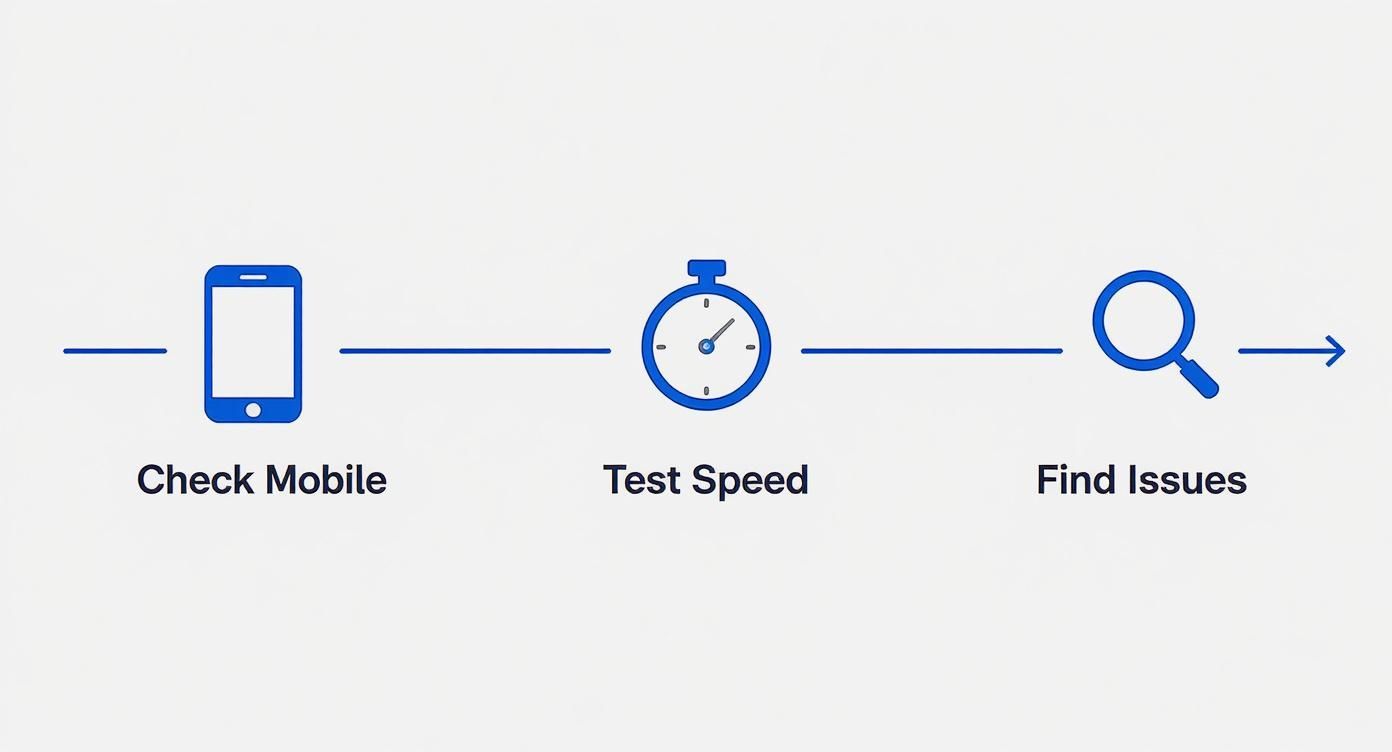
Before your content can be effective, you need a solid technical foundation. This means ensuring your site works well on mobile, loads quickly, and is free of technical errors that could hinder your performance.
From Raw Ideas to a Simple Content Plan
Once you have a list of customer questions and topics, you need to organise them. This doesn't require a complex spreadsheet; a simple calendar can work. The key is to plan content that helps people at different stages of their decision-making process.
It can be helpful to think in three phases:
- Awareness: The customer has a problem but isn't sure of the solution (e.g., a blog post on "5 signs you need a new roof").
- Consideration: They are actively exploring their options (e.g., an article comparing "flat roof vs pitched roof cost UK").
- Decision: They are ready to hire someone (e.g., a service page for "emergency roofers in Market Harborough").
A good content plan includes a mix of all three. This way, you’re not just targeting people ready to buy today, but you are also building a relationship with future customers.
Building a library of helpful, authoritative content is now a requirement. Google's algorithms have become very sophisticated at distinguishing between genuine expertise and low-value articles. The old strategy of publishing high volumes of content is no longer effective.
Recent algorithm updates have penalised sites that lack real expertise. In the UK, the impact has been clear. Data shows that around six in ten of the UK's largest news websites saw their Google visibility fall after the latest core updates. While outlets like The Guardian maintained their position with high-quality journalism, others that relied on volume saw a significant drop, which highlights the need for a quality-first approach.
How to Create Genuinely Useful Content
With a topic selected from your plan, the final step is to create the content. Whether it's a blog post, a service page, or a local guide, the goal is always to provide the best possible answer for that specific query.
A simple content brief can be very helpful. Before you start writing, note down:
- The primary question: What is the main problem this page will solve for the reader?
- Key points to cover: What essential sub-topics must be included to provide a complete answer?
- The next step: What do you want the reader to do after reading? Call for a quote? Download a guide? Make it clear.
For example, a local bakery writing about "sourdough starters" should do more than provide a definition. They should share their own tips, show photos of their process, and perhaps link to a video of their head baker. This demonstrates true expertise and creates content that is far more valuable—and more likely to rank—than a generic article.
Mastering Local SEO to Win Your Area

For most UK small businesses, competing for national rankings is not practical. The real opportunity is to win the local battle—appearing when customers in your immediate area search for your services. This is where local SEO is important. It helps you get found in "near me" searches and on Google Maps, driving real-world customers and phone calls.
Consider it from Google's perspective. When someone searches for "plumber in Market Harborough," its goal is to provide the most relevant, trustworthy local expert. Your job is to send clear signals that you are that expert. It starts with your most important local SEO asset: your Google Business Profile.
Your Google Business Profile Is Your Digital Shopfront
The information box on the right of the search results and in Google Maps is your Google Business Profile (GBP). It is often a potential customer's first impression of your business. Treating it as an afterthought is a mistake. A complete profile is one of the most powerful tools for improving local rankings.
Start with the fundamentals. Ensure your business name, address, phone number, and opening hours are complete and accurate. But the details are what make a difference.
- Choose the Right Categories: Be specific. Don't just list "Restaurant" when you could choose "Italian Restaurant." You have one primary category and can add several secondary ones, so be thorough.
- Write a Compelling Description: Use this space to explain what makes your business different and why customers should choose you.
- Upload High-Quality Photos: Show your premises, your team, and your work. Businesses with photos get 42% more requests for driving directions and 35% more clicks to their websites.
Getting the details right on your Google Business Profile is about building trust with both Google and your potential customers. An incomplete profile can look unprofessional and may make people question if you are still in business.
Don't forget to use features like Google Posts to share updates, offers, and news. This activity signals to Google that you are an active business, which can help improve your visibility.
The Power of Consistent Business Information
Once your GBP is updated, the next step is to ensure your core business information is identical everywhere it appears online. This refers to your NAP: Name, Address, and Phone number. Inconsistencies can be a red flag for search engines.
If one directory lists you as "Joe's Cafe Ltd." and another has "Joe's Cafe," Google may get confused and treat them as two separate businesses, which dilutes your authority. Establish one consistent version of your NAP and use it everywhere.
To improve your local rankings, you need to build these consistent listings (or 'citations') in reputable online directories. For UK businesses, some important ones include:
- Yell
- Thomson Local
- The Independent
- Yelp
- Your local Chamber of Commerce website
This can be a tedious process, but it is essential for building the local authority that Google rewards.
Earning Local Links and Building Relevance
Links from other websites act as votes of confidence. For local SEO, links from other businesses and organisations in your area are particularly valuable. They reinforce your connection to the community and prove your local relevance.
Look for practical opportunities in your local area. Sponsoring a local youth football team or a community event can often earn you a mention and a link on their website. These are the types of natural, relevant links that search engines value.
Another effective tactic is to create location-specific pages on your website. If you're a roofer in Leicester who also serves Loughborough and Hinckley, create dedicated service pages for each town. A page titled "Expert Roofing Services in Loughborough" has a better chance of ranking for that specific search. For a more detailed look, our guide on local SEO for service businesses offers more targeted advice.
When you combine a well-optimised Google Business Profile with consistent NAP information and locally relevant links and content, you send strong signals to Google that you are the best answer for customers searching in your area.
Building Authority Through Ethical Link Building
When another website links to yours, it's a public endorsement. To Google, these links are votes of confidence, signalling that your site is a credible source of information. The process of acquiring these links is called link building, and it is a key part of improving your Google rankings.
However, not all links are equal. The old practice of buying hundreds of low-quality links is no longer effective and can now lead to penalties from Google. For a local business, the goal is to earn high-quality, relevant links from other respected websites, especially those in your local area or industry. This is about building genuine relationships, not just collecting URLs.
Tap Into Your Existing Network
You likely already have link opportunities within your existing business relationships. These are often the easiest and most natural links to acquire.
Start by making a list of everyone you work with:
- Suppliers and Partners: If you have a good relationship with a supplier, ask if they have a partners or stockists page where they could add a link to your site.
- Trade Associations: If you are a member of a local Chamber of Commerce or an industry body, they usually have a members' directory. Check that your listing is present and includes a working link to your website.
- Charities and Sponsorships: If you sponsor a local team or donate to a community event, it's reasonable for them to thank you with a mention and a link on their website or social media.
This is not about cold outreach but about making your real-world relationships visible online.
A single link from a well-respected local organisation is more valuable than a hundred links from irrelevant, low-quality directories. Focus on quality and relevance over quantity.
Create Link-Worthy Local Resources
Another effective way to build authority is to create content on your website that people naturally want to share and link to. This shifts the focus from asking for links to earning them. A good approach for a local business is to create a genuinely useful local resource.
Think about what information would be helpful to your local community.
For example, a dog groomer in Bristol could create "The Ultimate Guide to Dog-Friendly Cafes in Bristol." This resource is not a direct sales pitch but offers great value to the target audience: local dog owners. Community blogs, local forums, and the cafes themselves would have a natural reason to link to such a guide.
Consider the unique knowledge you have. A local estate agent could create a guide to the best school catchment areas. A restaurant could publish a map of their local food suppliers. By positioning yourself as a source of useful local information, you naturally build your site's authority and attract the kind of high-quality links that improve your Google rankings.
Knowing if Your SEO is Actually Working
After putting in the work to improve your content and build links, how do you know if it's making a difference? Tracking your SEO performance is essential for understanding what is working and what to do next.
You don't need expensive software to get started. Two of the best tools are completely free: Google Analytics and Google Search Console. Together, they provide all the data you need to measure your progress.
Zero In on the Metrics That Matter
It's easy to get lost in data. As a local business, your goal is to connect with customers in your area, so focus on the numbers that reflect that. Concentrate on these key performance indicators (KPIs).
A quick monthly check-in on these three areas will give you a good overview:
- Keyword Rankings: Are you moving up in the search results for important terms? Check your average position in Google Search Console for searches like "emergency electrician in Chester." This shows your visibility.
- Organic Traffic Growth: Are more people finding you through Google? Google Analytics shows how many visitors come from organic search, a direct measure of your SEO's reach.
- Top Performing Pages: Which pages on your site are most popular? This shows what content resonates with your audience and can inform your future content strategy.
A piece of advice: don't focus on daily fluctuations. SEO is a long-term process. Look at month-on-month trends to see the real story of your growth.
A Simple Monthly Check-In System
You don't need a detailed report. A simple spreadsheet to record these key numbers at the start of each month is sufficient. The purpose is to spot patterns and make informed decisions.
For example, you might see that one of your service pages is on the second page of the search results. This is a significant opportunity. A small effort—such as a content refresh or adding a few more internal links to it—could be enough to move it to the first page, where most of the clicks happen.
Or perhaps your organic traffic is increasing, but you are not getting more phone calls. This could indicate that the content on your key pages is not effectively converting visitors into customers. Data can guide you on where to focus your efforts for the biggest impact.
Common Questions About Improving Google Rankings
Even with a plan, you might still have questions. When we talk to UK business owners about improving their Google rankings, a few topics come up frequently. Here are straightforward answers to the most common questions.
How Long Does It Take to See Results?
The honest answer is: it depends. SEO is a long-term strategy. If you are starting with a new website or one that has never had SEO work, it can realistically take six to twelve months to see strong, first-page rankings for competitive keywords.
For local businesses, the timeline is often shorter.
When you target local search terms with less competition—such as "emergency plumber in Kibworth"—you could see progress within three to six months. Some quick fixes, like optimising your Google Business Profile, can start to make a difference in a few weeks. The key is consistency, which builds momentum and delivers lasting results.
Do I Need to Pay for Google Ads to Rank Higher?
No. Google Ads and organic SEO are completely separate. Paying for ads can place you at the top of the page, but it has zero direct impact on your website's natural ranking in the unpaid listings.
However, running an ad campaign can provide valuable data. You can learn which keywords lead to phone calls or sales. You can then use these insights in your long-term SEO strategy, focusing on terms that you know are valuable to your business.
Should I Focus on My Website or Social Media?
When it comes to Google rankings, your website must be the number one priority. It is the one digital asset you completely own and control. Google's business is to rank websites, not social media profiles (though your profiles should appear when people search for your brand name).
Think of it this way: your website is your central hub, and social media channels are signposts directing people to it. Social media is great for building a community and driving traffic to your site. While this activity can indirectly support your SEO, the foundation of any ranking success is a well-built, authoritative website.
Ready to put this information into action? At Little Green Agency, we specialise in helping local businesses in Leicestershire and the Midlands achieve measurable online growth. A good first step is a free, no-obligation audit of your website so we can show you a path forward. Get your free SEO audit today.
