



Before you start searching for a digital marketing agency for a small business, it’s important to clarify one thing: what does success actually look like for you? It’s easy to jump straight into looking at agency websites and proposals, but without your own goals defined, it’s difficult to make an informed decision.
This first step is crucial. It ensures that any agency you partner with is focused on delivering real, tangible results that matter to your business.
Clarifying Your Goals Before You Begin the Search
Business owners often say, “I just need to be more visible online.” It’s an understandable starting point, but it’s too vague to build a successful marketing strategy around. To properly measure return on investment and hold an agency accountable, you need to turn those broad wishes into solid, measurable objectives.
Getting this part right is one of the most important things you’ll do in this whole process. It turns the search from a frustrating guessing game into a focused, strategic decision.
Let’s say you run a restaurant in the centre of Leicester. You don’t just want more website visitors; you want more customers. A much better goal would be: “Increase online table bookings by 30% within six months.” Now that is a specific Key Performance Indicator (KPI) an agency can work towards.
Or maybe you run an ecommerce shop out of Market Harborough. “More traffic” is nice, but it doesn’t pay the bills. A stronger goal is: “Generate 15 qualified leads per month from paid ads with a budget of £500.” See the difference?
From Vague Ideas to Actionable Targets
It’s all about refining your initial thoughts until they become specific business outcomes. Think of it as moving from a fuzzy idea to a sharp, high-definition picture of what you want to achieve.
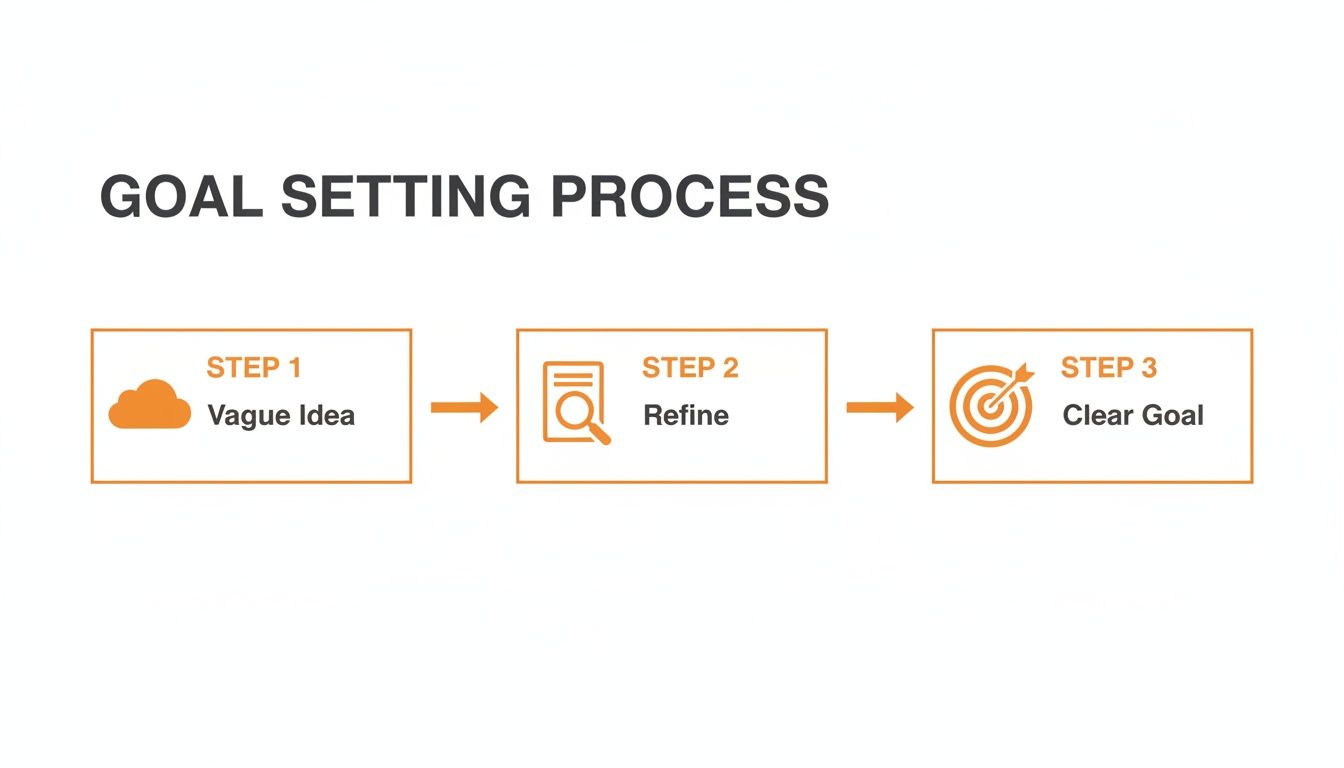
This simple diagram illustrates how you can funnel a general need into a concrete target that actually drives your marketing and lets you measure performance.
When you have these KPIs sorted from day one, it helps in two significant ways. First, you can go into conversations with potential agencies and tell them exactly what you need. Second, it gives you a solid yardstick to measure their proposals and, down the line, their actual work.
You can ask a potential partner, “How, specifically, will your strategy help me get that 30% increase in bookings?” rather than a vague question like, “How can you improve my online presence?”
Setting clear goals isn’t just about measuring success; it’s about defining what success means for your business. It makes sure every pound you spend on marketing is pushing towards a specific, valuable outcome.
Recent UK surveys show that while 60% of businesses say they have an SEO strategy, only around 20% bring in an external agency to run it. This often means businesses are trying to juggle it all in-house, sometimes without the specialist skills to set and hit those precise goals.
By defining your objectives first, you put yourself in a much stronger position to decide if an agency’s expertise is the right investment to get you there. You can read more UK digital marketing trends and stats over at localiq.co.uk.
Picking The Right Tools For The Job: Which Marketing Services Do You Actually Need?

So you’ve got your goals pinned down. That’s a huge step. Now, let’s figure out which digital marketing services will actually move the needle for your business. It’s easy to get overwhelmed by jargon, but for most small businesses, a handful of core services deliver the majority of results.
Think of it like this: you wouldn’t use a sledgehammer to hang a picture frame. The same logic applies here. If you need sales this month, a six-month content marketing plan isn’t your immediate answer. Let’s match the right tool to the right job.
Local SEO: Getting Found Around Leicestershire
For any business with a physical address—a café in Kibworth, a boutique in Market Harborough, or an accountant in the city centre—Local SEO isn’t just a good idea; it’s essential. This is all about making sure you show up when potential customers are searching for what you offer, right in your area.
When someone in Leicester types “best Sunday roast near me” into Google, you want your pub at the very top of that list. That’s what Local SEO does. It involves optimising your Google Business Profile, encouraging and managing reviews, and making sure your name, address, and phone number are consistent everywhere online. It’s the foundation for driving real-world foot traffic and local phone calls. You can dig deeper into what our own local SEO services involve to see how it works.
Pay-Per-Click (PPC): For When You Need Results Now
Need to get the phone ringing or drive traffic to a new product launch immediately? Pay-Per-Click (PPC) advertising is a good option. This is where you pay to place your ads at the top of Google search results for very specific keywords. For a Leicester-based e-commerce store, this means you can be right in front of a buyer the second they search for a product you sell.
The benefit of PPC is its speed and precision. You can set a strict budget, target people based on their location and interests, and see exactly what your return on investment is. However, without an expert hand guiding it, it’s easy to burn through your budget on clicks that go nowhere. So if researching an agency partner when serving a specific geography, you might search for google adwords leicestershire.
Content Marketing: Building Trust For The Long Haul
While PPC is a short-term tactic, content marketing is a long-term strategy. It’s about creating useful and relevant content—blog posts, guides, videos—that answers your customers’ questions and positions you as a knowledgeable expert in your field.
A professional services firm in Leicestershire, for instance, could write articles that simplify complex financial advice for small business owners. This builds trust long before a potential client is ready to pick up the phone. Over time, all that great content boosts your website’s authority with Google, creating a steady, reliable stream of organic traffic that you don’t have to pay for with every click.
The most effective approach is when you see these services not as separate items on a menu, but as interconnected parts of a bigger strategy. A smart approach often uses PPC to generate leads right away while Local SEO and content marketing build a powerful, long-term foundation for growth.
To help you connect the dots, this quick table breaks down how specific goals line up with the right marketing services.
Matching Marketing Services to Your Business Goals
| Your Business Goal | Primary Digital Marketing Service | Why It Works |
|---|---|---|
| Increase local foot traffic by 20% | Local SEO | Optimises your visibility on Google Maps and in “near me” searches, directly connecting with customers in your area. |
| Generate 15 qualified leads this month | Pay-Per-Click (PPC) Advertising | Drives immediate, highly-targeted traffic from users actively searching for your services, offering quick and measurable results. |
| Become the go-to expert in your niche | Content Marketing | Builds authority and trust by providing valuable information, attracting a loyal audience and boosting organic search rankings over time. |
By understanding what each service is designed to do, you can have a much more productive conversation with a potential agency and ensure their proposal is actually built to deliver what you need.
How to Properly Vet a Potential Marketing Agency
Alright, you’ve got a shortlist of agencies. Now for the crucial part. Picking a marketing partner is a serious investment for any small business, so you need to look past the presentation and figure out what they’re really made of. This is all about making sure they have the right skills and understand the challenges you’re up against.
A decent agency won’t just talk about what they can do; they’ll have the results to prove it. Your job is to ask the right questions and know what a good answer looks like. This is how you find someone who can genuinely help you grow, not just take your money.
Look for Relevant Experience and Proof
The first thing you should be asking is, “Have you worked with a business like mine before?” It’s a simple question, but the answer tells you a lot. Have they worked with other local businesses in your sector? Even better, have they got a track record with SMEs right here in Leicestershire? An agency with that local insight has a head start – they already know the area, what local customers want, and who you’re competing against.
When they start showing you case studies, it’s time to look closer.
- Look past the fluff: A spike in website traffic is fine, but did that traffic actually lead to more phone calls, bookings, or sales? That’s what really matters.
- Ask for the details: If they boast about increasing leads by 50%, get them to explain exactly how they measured that. Was it through contact form fills? Clicks on your phone number? Be specific.
- Check the timeline: How long did it take to get those results? This is key to setting realistic expectations for your own campaign.
Remember, real results are tied to your bottom line, not just abstract numbers like clicks and impressions.
The point of vetting an agency isn’t just to find out if they’re good at marketing; it’s to see if they’re good at marketing your kind of business. A portfolio stacked with national e-commerce giants doesn’t prove they can help a local Leicester restaurant get more customers mid-week.
Analyse Their Technical Understanding
A good agency can break down complex ideas into plain English. Ask them about their approach to technical SEO. They should be able to walk you through how they’d improve your site’s performance without drowning you in jargon.
This is also a great test of their transparency. Will they give you access to your own data? For instance, knowing your way around Google’s own tools is a must. You can get a feel for the basics with our guide on how to use Google Search Console, which shows you the kind of data any good agency should be using daily.
Read Between the Lines of Testimonials
Client testimonials are a great starting point, but you need to read them carefully. Look for feedback that goes beyond just the end results and touches on the working relationship, their communication style, and how they handle challenges.
Ask yourself these questions:
- Are the testimonials from businesses of a similar size and in a similar industry to yours?
- Do they mention specific people at the agency? That often points to a strong, personal connection.
- Are they recent? An agency’s quality and team can change over time.
Don’t be shy about asking if you can have a quick chat with one of their current or even past clients. An agency that’s confident in its work will have no problem with this. A ten-minute phone call with a real client can tell you more than any sales pitch ever will.
Understanding Agency Pricing Models and Contracts
Let’s talk about money and contracts. It’s a conversation you have to get right with any potential digital marketing agency for your small business. Establishing the financial structure and legal terms from the outset protects you and lays the groundwork for a transparent, healthy partnership.
Think of agency fees less as a cost and more as an investment. But like any investment, you need to know precisely what you’re paying for and what you should expect in return. Let’s look at the common pricing models you’ll encounter and what they mean for your budget.
Common Pricing Structures Explained
Most agencies catering to small businesses stick to a few core pricing models. Each has its pros and cons, and understanding them is key to comparing proposals fairly.
- Monthly Retainer: This is the industry standard. You pay a set fee each month for a clearly defined scope of work—think ongoing SEO, content creation, or PPC management. It’s helpful for budgeting because it’s predictable, but you must have it in writing exactly what that fee includes.
- Project-Based Pricing: This is a one-off, fixed fee for a specific task with a clear start and finish, like a website build or a detailed SEO audit. It’s a good way to test the waters with an agency without a long-term commitment.
- Hourly Rate: Some freelancers or smaller agencies might charge by the hour. While this offers flexibility for small, one-off jobs, the costs can escalate quickly if the scope isn’t tightly controlled.
In the UK, digital ad spending is projected to pass £40 billion. This puts pressure on costs, especially for paid ads. A good agency knows this and will focus on getting the most value from your budget, often using clever local targeting to get you a measurable return. You can see more on this trend with these UK digital marketing stats from searchhog.co.uk.
The best pricing model really hinges on your goals. A monthly retainer is ideal for the long game of SEO. For a one-time fix like a new website, a project fee just makes more sense.
Reading the Small Print: Red Flags to Watch For
The contract isn’t just a piece of paper; it’s your rulebook and your safety net. A fair, SME-friendly agreement is always built on clarity, not confusion.
From our experience, here are a few red flags you need to look for in any agency agreement:
- Long lock-in periods: Be wary of any contract demanding a 12-month commitment from day one. An agency that’s confident in its ability to deliver results will often offer a shorter initial term (e.g., 3-6 months) or a rolling monthly agreement after a trial period.
- Vague deliverables: If the contract simply says “SEO services,” push back. It needs to spell out the specifics: “monthly technical site health check,” “four 1,000-word blog posts per month,” or “weekly PPC performance report with commentary.”
- Unclear ownership: This is a big one. You must own your digital assets. The contract must explicitly state that you have full ownership and admin-level access to your website, Google Analytics, Google Ads account, and all social media profiles. Never let an agency hold your own accounts hostage.
Testing the Waters with a Trial Project
Before you commit to a long-term contract, it’s a good idea to see how an agency actually performs. Think of it as a test drive. You wouldn’t buy a car without one, so why lock yourself into a 12-month marketing retainer without seeing what they can do first?
Starting with a small, self-contained project is a smart way to get a feel for their working style, communication, and real-world expertise. This isn’t just about vetting their skills; it’s about seeing if you genuinely click. It’s a low-risk way to turn their sales pitch into tangible proof.
Structuring a Meaningful Trial
So, what does a good trial project look like? Instead of diving straight into a six-month commitment, propose a one-off project with a clear beginning and end. This gives you a specific deliverable to judge them on.
A few good options for a test run include:
- A Local SEO Audit: Have them conduct a deep-dive into your online presence right here in Leicestershire. This should cover everything from your Google Business Profile and local directory listings to a proper analysis of what your direct competitors are doing. The end result should be a report that isn’t just full of data, but gives you clear, actionable steps to take.
- A Small, Focused PPC Campaign: Ask them to run a tight, one-month Google Ads campaign for a single product or service. This is a great way to see how they handle your budget, the quality of their ad copy, and how they report back on crucial metrics like cost per lead or click-through rate.
A trial project is the ultimate reality check. It moves the conversation from hypothetical strategies to tangible results, giving you the confidence to decide whether a longer-term partnership is the right move for your business.
The information you get from a trial is invaluable. A technical SEO audit, for example, might uncover website issues that could slow down your progress later on. If you’re curious about typical timelines, we break down how long SEO takes to work in another guide.
Ultimately, the trial results give you everything you need to make an informed decision, not just a gut feeling.
Building a Strong Partnership from Day One

You’ve signed the contract and picked your agency. Now the real work begins. Those first few weeks are crucial – they set the tone for the entire relationship. A strong start isn’t built on a vague promise to “get started soon”; it’s built on a structured, professional onboarding process.
This is the phase where the agency stops being an outsider and becomes an extension of your team. They need to get to know your business, understand what makes it tick, and lay the proper groundwork for the campaigns ahead. Any decent agency will take the lead here with a clear plan.
What to Expect in the First Month
A good onboarding process should feel logical and organised, not chaotic. It’s the agency’s job to guide you through it, making sure no stone is left unturned. You should feel that you’re in safe hands.
To help you gauge if things are on the right track, here’s a quick rundown of what a productive first month should look like:
- The Kick-Off Workshop: This is a deep-dive session. It’s where you’ll go over your business goals, target customers, and key competitors to agree on the immediate priorities.
- Sorting Out Access: They’ll need access to things like your website’s back-end, Google Analytics, and any ad accounts you already have. This should be handled securely and professionally.
- A Clear Point of Contact: You need to know exactly who you’re dealing with day-to-day and the best way to get hold of them.
- Agreeing on Reporting: Get clarity from the start on how often you’ll see performance reports (is it weekly? monthly?) and, just as importantly, what metrics they’ll actually include.
A well-run onboarding isn’t just about ticking boxes. It’s the first real test of an agency’s project management and communication skills. It sets a precedent for how transparent and collaborative they’ll be for the rest of your time together.
Recent UK research shows that small businesses often need very specific support. With 67% of B2B marketers calling PPC essential, it’s no surprise many are outsourcing specialised tasks like content marketing (23%) and AI-powered search optimisation (23%). This highlights how vital it is to get on the same page about deliverables from day one. You can find more data in these UK digital marketing statistics.
Frequently Asked
Choosing a digital marketing agency always brings up a few key questions. Here are some straightforward answers to the things we get asked most often.
How Much Should a Small Business Budget For Marketing?
Marketing costs can vary widely depending on what you need. A focused local SEO campaign might start from a few hundred pounds a month. But if you’re looking for a full strategy with PPC, content marketing, and web design, the cost will naturally be higher.
For most small to medium-sized businesses, a realistic monthly budget often falls somewhere in the £500 to £2,000 range. The most important thing isn’t to find the cheapest option, but to find the one that delivers the best return on your investment.
How Long Until I See Results?
It really depends on the marketing channel. Pay-per-click (PPC) advertising is built for speed; you can start seeing traffic and enquiries almost as soon as the campaigns go live. It’s a great way to generate leads quickly.
SEO, on the other hand, is a marathon, not a sprint. You should start seeing some positive movement—like better rankings for certain keywords—within 3 to 4 months. But the most meaningful results usually take shape after 6 to 12 months of consistent effort as your site builds authority.
Hiring a digital marketing agency for a small business isn’t a quick fix; it’s a strategic partnership. Immediate results from PPC should be balanced with the steady, cumulative growth that comes from a solid SEO foundation.
Should I Hire a Local or National Agency?
For a business rooted in Leicestershire, there’s a strong case for going local. A local agency understands the nuances of the Leicester market, who your local competitors are, and what makes local customers choose one business over another.
You also tend to get a more personal service. With a smaller, local team, you’re more likely to have a direct line to the people actually doing the work. That local insight can be a real advantage, helping you connect with the community in a way a national agency might not be able to replicate.
At Little Green Agency, we’ve spent over 20 years getting to know the Leicestershire business community. We blend deep local knowledge with proven, marketing-qualified strategies to help businesses like yours grow. If that sounds like the kind of transparent, results-focused partnership you’re after, let’s have a chat.

Leave a Reply