

Choosing between building an in-house marketing team or hiring an agency is a major strategic decision for any small business. There isn’t a single right answer. An in-house marketer can offer unmatched focus on your brand, while working with a Leicester SEO agency provides a team of specialists and professional resources from day one.
Ultimately, the best choice depends on your business goals, budget, and the specific skills you need right now to grow.
Understanding the Core Decision
For many UK business owners, marketing can feel like a constant juggling act. You know you need to improve your online presence, but deciding where to invest your time and money is a challenge. This is where the in-house vs. agency debate begins. Each option has different benefits and drawbacks, and your choice will directly impact your business’s growth.
The goal isn’t to find a “perfect” solution but to find the right fit for your business today. This guide will provide a practical look at what each model means for your daily operations and long-term plans, helping you weigh them up across the areas that matter most.
Here’s a quick overview of the key differences:
| Aspect | In-House Marketing Team | Marketing Agency Partner |
|---|---|---|
| Expertise | Deep knowledge of your specific brand and industry. | Broad expertise across multiple marketing disciplines. |
| Cost Structure | Fixed costs (salary, benefits, training, tools). | Variable costs (monthly retainer or project fees). |
| Resources | Limited to the skills of the person(s) you hire. | Access to a full team of specialists and premium tools. |
| Focus | 100% dedicated to your business and its objectives. | Manages multiple clients, balancing priorities. |
| Scalability | Scaling up or down requires a slow hiring process. | Can quickly adapt resources to meet campaign demands. |
We’ll break down these points with practical examples relevant to UK SMEs. From the true cost of a full-time employee to the specialist knowledge needed for effective SEO services, this guide will give you the clarity needed to invest confidently in your company’s future.
When comparing in-house marketing with hiring an agency, the first consideration for most is cost. It’s a natural starting point. You see a potential salary, you see a monthly retainer, and you compare the two figures. But this simple comparison doesn’t show the full picture.
The real cost of hiring an in-house marketer in the UK involves much more than just their annual salary. To get an accurate financial understanding, you need to account for all the additional expenses that are often overlooked.
The Hidden Costs of an In-House Hire
Taking on a new team member is a significant commitment, and the costs add up quickly beyond their monthly salary. You need to factor in:
- Recruitment Fees: Finding the right person can be difficult. Using a recruitment agency can cost 15-20% of the first year’s salary.
- National Insurance & Pension: Employer contributions are mandatory and add a significant amount to your payroll expenses.
- Benefits & Paid Leave: Holiday pay, sick leave, and other benefits are all part of the real cost of employment.
- Equipment & Software: Your new employee will need a computer, a workspace, and access to professional marketing tools. Subscriptions to platforms like SEMrush or Ahrefs can cost thousands of pounds a year.
- Ongoing Training: The marketing industry changes quickly. To remain effective, your employee will need continuous professional development, which means paying for courses, workshops, and conferences.
When you add it all up, the actual cost of a single in-house marketer can easily be 25-40% higher than their base salary.
As you can see from the data, most businesses still lean towards building their own teams, but a significant portion rely on agency expertise or a mix of both.
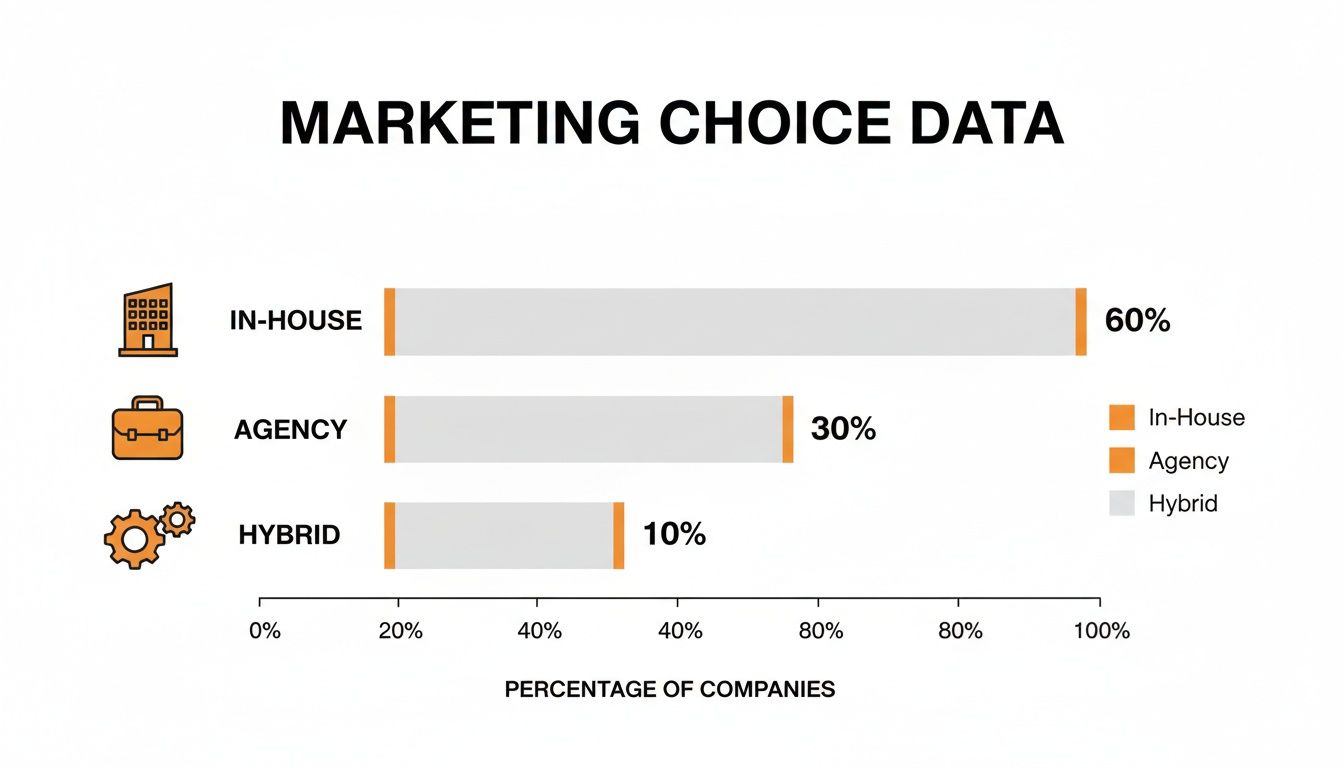
This split shows there’s no single “right” answer; the best approach really depends on a company’s resources, goals, and stage of growth.
Agency Retainers: The All-Inclusive Approach
An agency model works differently. The monthly retainer is typically a single, predictable fee that covers a wide range of services. While retainers for UK SMEs can range from £1,000 to over £3,000 monthly, that fee gives you access to an entire team of specialists—SEO strategists, content writers, PPC experts, designers—without any of the hiring overheads.
The agency also covers the high cost of premium tools and software. We pay for the expensive subscriptions, not you. This is a crucial point many people miss when they explore how market trends are shaping marketing choices.
To put it into perspective, here’s a clearer breakdown of how those annual costs really compare.
Annual Cost Breakdown: In-House Marketer vs Agency Retainer
This table provides a side-by-side look at the true annual costs. We’ve used a typical salary for a marketing manager and a modest agency retainer to show how the numbers stack up once you account for all the hidden expenses.
| Expense Category | In-House Marketer (Annual Estimate) | Marketing Agency (Annual Estimate) |
|---|---|---|
| Base Salary / Retainer Fee | £40,000 | £24,000 (£2,000/month) |
| Recruitment Fees (15%) | £6,000 | £0 |
| Employer NI & Pension (~15%) | £6,000 | £0 |
| Benefits & Paid Leave | £4,500 | £0 |
| Equipment & Office Space | £2,500 | £0 |
| Marketing Software & Tools | £3,000 | Included |
| Training & Development | £1,500 | Included |
| Management Overhead | Variable | Included |
| TOTAL ANNUAL COST | £63,500 | £24,000 |
As you can see, the initial salary is just the tip of the iceberg. The agency retainer, while a significant investment, often proves to be the more cost-effective and predictable option for many small businesses. You know exactly what you’re paying each month, with no surprises.
An agency gives you access to a diverse, specialised skillset for a fixed monthly cost. It removes the unpredictable expenses and long-term commitments that come with hiring an employee. You pay for the results, not the overheads.
Skills on Tap: The Specialist vs. The Generalist
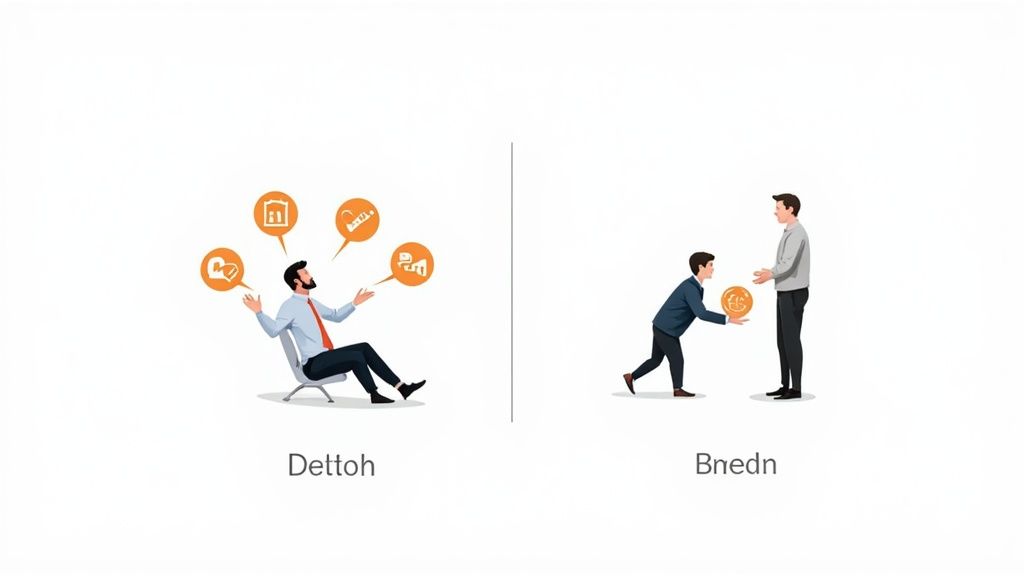
When you’re comparing an in-house marketer with an agency, one of the biggest factors is the type of expertise you’re getting. It’s not simply a case of one being better than the other. It’s a fundamental trade-off between the depth of a dedicated employee and the breadth of a full team.
An in-house hire offers unmatched depth. They become a true brand expert who deeply understands your products, customers, and company culture. This complete dedication means they can move quickly on internal projects and ensure every marketing message captures your brand’s voice.
The In-House Advantage: Deep Brand Immersion
Your in-house marketer is part of your team every day. This total immersion gives them a grasp of your business that an external partner would struggle to replicate.
For example, a local, family-run café thrives on its community atmosphere. An in-house social media manager can be there to take photos of the morning rush, share daily specials as they are prepared, and reply instantly to customer comments. Their on-the-ground knowledge makes the marketing feel genuine and personal.
The challenge? Finding one person who is an expert in all areas of marketing. Modern marketing is complex, requiring knowledge of technical SEO, data analytics, creative copywriting, and paid ad management. It’s rare for one individual to excel at all of them.
An in-house marketer’s greatest strength is their focused, deep knowledge of your brand, which is excellent for maintaining consistency and authenticity. The downside is that you’re relying on one person to cover a wide range of marketing disciplines.
This is where an agency brings a completely different value proposition.
The Agency Advantage: A Full Team of Experts
Partnering with a marketing agency is like getting an entire, experienced marketing department overnight. Instead of hiring one person to do everything, you get a team of specialists.
Your business goals are supported by individuals who spend their days focused on their specific craft. A typical campaign might involve:
- An SEO specialist who stays up-to-date with the latest Google algorithm changes.
- A PPC manager who knows how to get the most value from your ad budget.
- A content writer who creates articles that appeal to both people and search engines.
- A web developer ready to fix any technical issues affecting your site.
Agencies also offer a wider perspective from working with clients across different industries. They can apply successful strategies from other sectors to your business, keeping your marketing fresh and innovative.
Plus, they come with a professional toolkit already in place. If you’re curious, you can explore some of the best SEO tools for small business in our guide. This combination of collective expertise and ready-to-go resources is a significant advantage for complex campaigns.
Control, Speed, and Scalability: Finding the Right Pace
For many business owners, having direct control over marketing is a major benefit. It allows for quick decisions and immediate implementation. An in-house marketer provides that direct line of communication.
If you have an idea for a last-minute social media post or need an urgent change to a landing page, you can simply talk to them directly. This level of integration is great for ensuring your marketing reflects your company culture and brand voice.
The In-House Growth Hurdle
The problem is, this model can become a limitation when it’s time to grow. Hiring is a slow, costly process involving recruitment fees, interviews, and onboarding. If you need to launch a major campaign next month, a single marketer or a small team can quickly become overwhelmed, creating a bottleneck that slows your momentum.
Similarly, what do you do during a quiet period? Downsizing is difficult and can negatively affect morale. This rigidity can be a real challenge for small businesses that need to be agile to compete.
This has led to a significant shift in the UK. A recent study found that 88% of brands now have some form of in-house creative or marketing team, an increase of 10% in just five years. It shows a clear desire to bring speed and control closer to home. You can read more about this trend towards in-house teams.
The Agency Edge: Built-in Agility
This is where an agency truly excels. Agencies are designed to be flexible. They can allocate more resources for a new product launch one month and then scale back the next, all without you having to deal with long-term HR issues.
While you might lose some minute-by-minute control, a good agency partner works proactively to stay aligned with your goals. Through regular check-ins, clear communication, and detailed reports, they act as an extension of your team—one that is both responsive and forward-thinking.
An agency offers an operational flexibility that’s difficult to replicate in-house. It’s the ability to scale your marketing efforts up or down in line with your business needs, so you’re never paying for resources you don’t need or missing out when an opportunity arises.
Think about launching a new local SEO campaign. An agency can assign a full team of specialists—an SEO strategist, a content writer, a link-building expert—to start immediately and achieve results quickly. That kind of speed can be a game-changer, and if you’re wondering how long SEO takes to work, having a dedicated team can shorten the timeline.
Ultimately, the choice comes down to what you value more: the immediate, hands-on control of an in-house team or the strategic, scalable flexibility an agency provides.
Finding the Smart Solution: The Hybrid Model
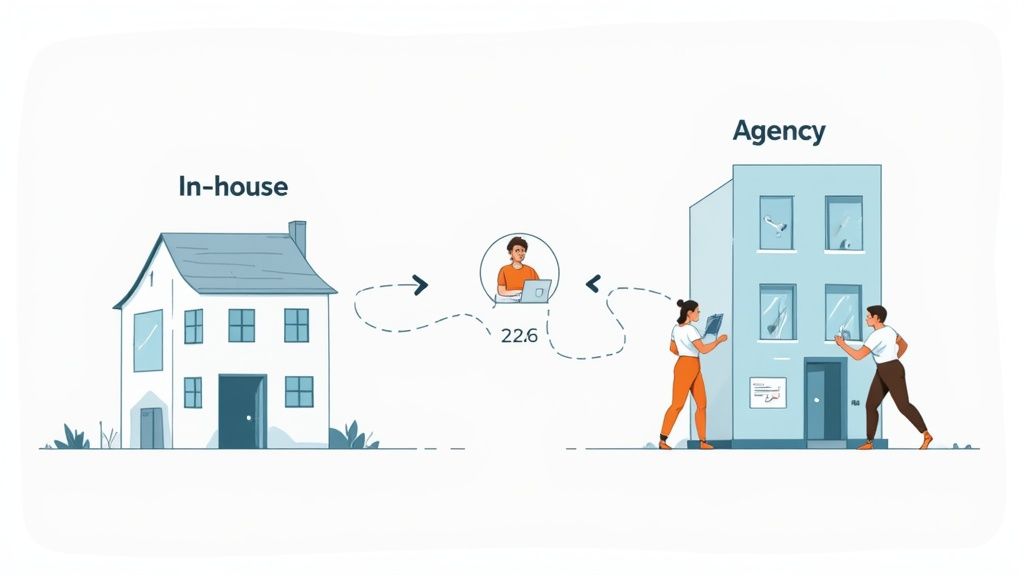
The debate over in-house marketing vs. an agency often seems like an either/or choice. But for many growing SMEs, the smartest path isn’t about picking a side. It’s about creating a powerful combination of both: the hybrid model.
This approach gives you the best of both worlds. You get the deep brand knowledge and day-to-day focus of an in-house marketer, supported by the specialised skills and broad resources of an external agency. The result is a flexible, effective, and cost-efficient marketing function that can grow with your business.
How the Hybrid Model Works in Practice
So, what does this actually look like? Typically, a business will have an in-house marketing coordinator or manager who acts as the central point for all marketing activities. This person understands the brand, handles daily tasks, and maintains a consistent company voice.
They also become the main point of contact for an agency partner. The agency then provides high-level strategy and executes the complex, technical jobs that require specialist expertise. This division of labour allows everyone to focus on their strengths.
Here are a few common ways this partnership works:
- Content and SEO: Your in-house coordinator writes blog posts and manages social media, while the agency handles technical site audits, keyword strategy, and building valuable backlinks.
- Lead Generation: The internal marketer qualifies new leads and creates email newsletters, while the agency runs paid advertising campaigns on Google and social media.
- Website Management: Your in-house person updates product pages and company news, leaving the agency to manage website security, conversion rate optimisation, and any complex development work.
The hybrid model isn’t a compromise; it’s a strategic advantage. It gives you an internal brand champion for day-to-day consistency and an external team of specialists to drive technical performance and growth, all without the full overhead of a large in-house department.
This structure allows SMEs to maintain full control over their brand and have internal ownership, while also accessing the advanced skills needed to compete effectively online. It removes the pressure of finding one “unicorn” employee who can do everything, building a more sustainable and scalable foundation for your marketing.
A Simple Framework for Making Your Decision
Deciding between hiring in-house, partnering with an agency, or trying a hybrid approach comes down to your business’s current situation. It’s easy to get lost in the debate, so let’s simplify it with a few direct questions.
There’s no magic formula, just the right fit for your specific circumstances. This framework will help you clarify the four areas that matter most for a growing business.
Take Stock of Your Current Resources
First, be honest about your budget and internal capacity. This isn’t about what you wish you had, but what you can realistically commit to today.
- What’s your real monthly marketing budget? Consider not just a salary or retainer fee, but also ad spend, software subscriptions, and other hidden costs.
- How much leadership time can you spare? An in-house marketer needs management and clear direction. If you are already very busy, you might need a partner who can take the strategic lead, not someone who needs constant guidance.
Pinpoint Your Most Urgent Skill Gaps
Next, be specific about the expertise you need to achieve your most critical goals. Are you trying to build a social media following, or do you need to improve your technical SEO rankings? The required skills are very different.
- What are your top 1-2 marketing priorities for the next six months? If the answer is “get to the top of Google for local searches,” you need an experienced SEO specialist. If it’s “engage with our customers daily,” you’re looking for a community manager.
- Do you need a specialist or a generalist right now? A focused skillset, often found in an in-house hire, serves different goals than the broad, multi-channel capabilities an agency brings.
Your most pressing need should drive the decision. A common mistake is to hire for a problem you might have in a year. If your website visitors aren’t converting, you need a conversion rate optimisation expert today—not a social media guru for a future campaign.
Answering these questions moves the decision from a gut feeling to a sound business calculation. It’s about aligning the resources you have with the goals you need to achieve.
Got Questions? We’ve Got Answers
Deciding between hiring in-house and partnering with an agency raises many questions. To help clarify, here are straightforward answers to the questions we hear most often from UK business owners.
Is It Cheaper to Hire a Marketing Agency or an Employee?
Initially, an agency often appears to be the cheaper option. When you add up the real cost of an employee—salary, National Insurance, pension, recruitment fees, software, and training—it’s a significant investment. If you need a range of skills, an agency provides that expertise for a fraction of the cost.
However, if your marketing needs are very specific, such as someone to manage your social media accounts daily, a single, dedicated employee might offer better long-term value. It depends on the tasks required.
How Do I Actually Manage a Marketing Agency Effectively?
Getting the best out of an agency is about partnership, not micromanagement. A strong relationship is built on clear communication and shared goals from the start.
Here’s how to make it work:
- Provide a clear brief: Give them a detailed overview of your business goals, target customers, and what success looks like for you. The more context they have, the better their work will be.
- Agree on metrics: Set clear, measurable Key Performance Indicators (KPIs) from the beginning. How will you both track progress and success?
- Maintain communication: Regular check-ins, whether weekly or fortnightly, are essential to keep everyone aligned and maintain momentum.
Think of your agency as an extension of your team. The more you involve them in your business, the better the results will be.
Can I Switch From an Agency to an In-House Team Later On?
Yes, absolutely. It’s a natural progression for many growing businesses. You might start with an agency to establish your marketing and then build your own team once you have the necessary scale and budget.
A good agency will anticipate this and help you make a smooth transition. To ensure it goes well, plan the handover in advance. Work with them to document all key processes and confirm you have full ownership of all your digital assets—your website, analytics accounts, and ad platforms. A true partner will want to see you succeed, even after your contract ends.
The in-house vs agency decision ultimately comes down to where you want to invest: in building internal capability, or in buying proven external expertise. If the agency model appeals but you want to understand exactly who you’d be working with, our about page explains who we are and how we work — including why we deliberately focus on SMEs rather than trying to serve everyone.
Ready to get expert advice tailored to your business goals? The team at Little Green Agency has over 20 years of experience and has recently become a specialist in saas Seo. Start with a free, no-obligation SEO audit to see how we can help.



Leave a Reply