



It’s the question we hear all the time: "How long does SEO actually take to work?"
The honest, straightforward answer is that you can expect to see early signs of progress in 4-6 months. For the kind of results that genuinely grow your business – consistent enquiries, more sales, and a real impact on your bottom line – you’re typically looking at 12 months or more.
SEO is not a quick fix. It's a long-term investment in your business's online visibility.
Setting Realistic SEO Expectations

When you invest your hard-earned money into growing your business, you deserve clear answers. At Little Green Agency, we’ve spent over 20 years helping businesses like yours, and we know that trust is built on clarity, not vague promises.
Think of SEO like planting an oak tree. You could plant a weed, and it would shoot up in a few days. But it has no strength or real value. An oak tree is different. It needs a solid foundation, consistent care, and patience. It takes time for its roots to grow deep, but once established, it becomes a powerful, lasting asset that stands strong for years.
Your SEO journey is the same. We start by laying that solid groundwork – fixing technical issues, finding the right keywords for your customers, and understanding your local market. From there, we nurture its growth with high-quality content and by building your website's authority online.
Why Every Business Timeline Is Unique
It’s important to understand that there’s no one-size-fits-all timeline. While the 4-12 month range is a solid benchmark, your specific path will depend on a handful of key factors. These variables determine how quickly your own "oak tree" can grow.
A few of the most important factors include:
- Your Website's History: Is your domain brand new, or does it already have some history and trust with Google?
- Local Competition: Are you a plumber in a quiet village or a restaurant in a busy city centre like Manchester?
- Your Budget and Resources: The level of investment directly influences how much we can do and how quickly.
- The Technical Health of Your Site: A well-built website provides a significant head start compared to one with underlying technical problems.
Your SEO strategy isn't just about climbing rankings; it's about building a sustainable source of enquiries and sales for your business. This requires a methodical approach, not a sprint.
A Realistic SEO Results Timeline
To give you a clearer picture, here’s a breakdown of what a small UK business can typically expect at each stage of an SEO campaign.
| Timeframe | Typical Activities | Expected Outcomes |
|---|---|---|
| Months 1-3 | Technical audit, keyword research, on-page optimisation, Google Business Profile setup. | Foundational issues fixed. Early signs of improved keyword rankings for low-competition terms. Increased local visibility. |
| Months 4-6 | Consistent content creation (blogs, service pages), local citation building, initial link-building outreach. | Noticeable gains in organic traffic. More keywords appearing on pages 2-3 of Google. Increase in local map pack rankings. |
| Months 7-12 | Advanced content strategies, targeted link building, conversion rate optimisation (CRO). | Significant traffic growth. Key commercial terms reach page 1. A clear increase in leads, phone calls, or online sales. |
| 12+ Months | Ongoing optimisation, targeting highly competitive keywords, expanding service/location pages. | Established authority in your niche. Consistent flow of organic leads. High rankings for valuable keywords are maintained and defended. |
This table provides a general guide. Remember, the goal is to build momentum that delivers lasting value, not just a temporary spike in traffic.
The Value of Patience and Persistence
The timeline can feel long, but the reward for sticking with it is significant. Reaching the top spots on Google is a game-changer; the first organic result gets an average click-through rate of 27.4%, which drops to just 15.6% for the second position. You can explore more figures in these Google SEO statistics.
Throughout this guide, we'll break down what to expect month-by-month and show you how to measure success every step of the way. Our aim is to demystify the process and give you a clear, realistic picture of what it takes to succeed online.
What Actually Affects Your SEO Timeline?
We’ve talked about a general 4-12 month window, but you’re probably wondering why it takes that long. There’s no single answer. Your SEO timeline is unique, shaped by a handful of critical factors specific to your business and market.
Think of it like driving from London to Edinburgh. The time it takes depends on your car, the route you choose, and how much traffic you encounter. SEO is no different. Understanding these factors is key to setting realistic expectations.
Your Website's Age and History
A website's history, often called its domain authority, plays a significant role. Are we working with a brand-new website or an established one that’s been around for years?
A new website is like a new shop that’s just opened. No one knows it’s there, and it has no reputation. Google is naturally cautious. It takes time to prove that your site is a trustworthy source of valuable information.
On the other hand, an older, established website is more like a well-known shop on the high street. It already has history, customers (or in SEO terms, backlinks), and a reputation. Google has been indexing it for a while, understands what it’s about, and is more likely to give it a head start.
How Fierce is Your Competition?
The level of competition in your industry has a major impact on how long SEO takes. Are you a plumber aiming to be number one in a small village, or are you a solicitor targeting the top spot in central London? The difference is considerable.
Let's use a simple analogy: running a race.
- Low Competition (Local 5k): If you're a specialist tradesperson in a small town with only a few direct competitors, getting to the top of local search is like training for a 5k run. With consistent effort, you can reach that goal relatively quickly.
- High Competition (London Marathon): If you're an e-commerce store selling a popular product nationwide, you're competing against established giants. This is like training for the London Marathon. It requires a much more intense, long-term strategy just to place, let alone win.
Gauging your competition is one of the first things we do, as it directly shapes the strategy and timeline.
Your Content Strategy (or Lack Thereof)
Content is the fuel for your SEO. It’s how you answer your customers’ questions, demonstrate your expertise, and give Google a reason to rank you. A site with thin, outdated, or poorly written content will always struggle.
Imagine your website is a library. If it only has a few old pamphlets, visitors won't stay long, and they won't see you as an authority. But if your library is full of well-organised, insightful books that answer their exact questions, they’ll keep coming back.
Creating high-quality, genuinely helpful content on a consistent basis is non-negotiable. It signals to Google that you're an expert in your field, which is essential for building the trust needed to rank well.
The Strength of Your Backlink Profile
Backlinks are simply links from other websites pointing to yours. In Google’s eyes, every backlink acts as a vote of confidence—a bit like a professional recommendation. A strong profile of links from relevant, reputable websites tells search engines that your site is a trusted resource.
Building a quality backlink profile takes time. It’s about creating content that’s worth linking to and nurturing relationships in your industry. A site with zero backlinks is starting from scratch, while a site that has already earned some quality links has a significant advantage.
The Technical Health of Your Website
Finally, none of the above matters if your website's technical foundation is poor. A site that’s slow, difficult to use on mobile, or full of broken links is like a house built on sand. Before you can think about adding new content, you have to fix the foundations.
This is why a technical audit is always our first step. It lets us find and fix any underlying issues that could be holding your site back. You can get a quick look at your site’s health by using some of the best free SEO audit tools available.
We also have to remember that Google can change the rules at any time. For instance, a hypothetical Google core update in June 2025 could lead to a large spike in website impressions for around 85% of UK sites almost overnight. While this would create a sudden jump in visibility, it wouldn't necessarily translate to stable, long-term traffic, proving that SEO is a continuous process of adaptation and effort.
Your Realistic Month-by-Month SEO Roadmap
It's one thing to hear that SEO is a long-term strategy, but it's more useful to know what that journey looks like. Let's turn the abstract idea of "doing SEO" into a concrete, month-by-month plan. This roadmap shows what's happening behind the scenes and the kind of results you can realistically expect at each stage.
Think of it like building a house. You can't start hanging pictures on the wall before the foundations are poured and the framework is up. SEO works in the same way, with each phase building on the last.
This visual shows how three critical factors—your domain's age, the quality of your content, and the backlinks you earn—all come together over time.
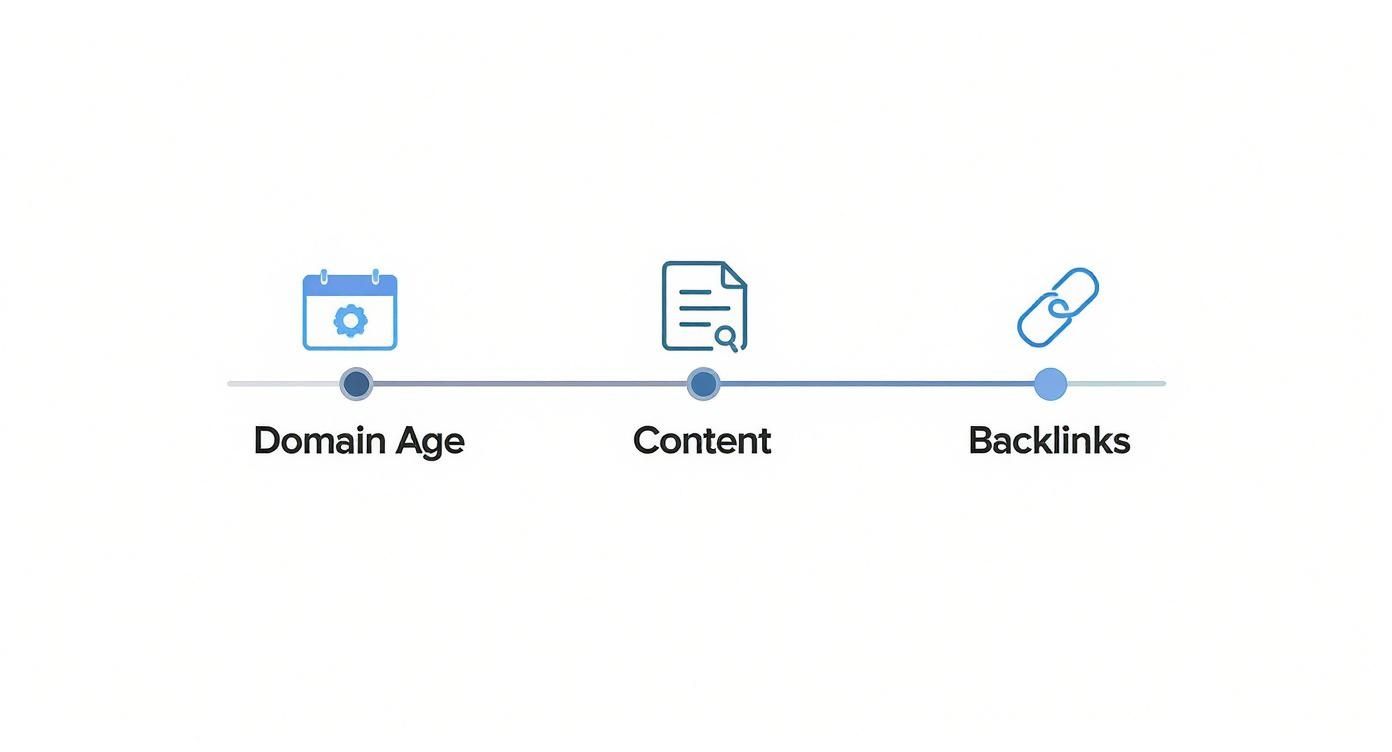
As you can see, these elements have a compounding effect. The work put in during the early months is what fuels the more significant results you'll see later in the year.
Months 1-3: Laying the Foundation
The first three months are all about groundwork. It’s a less glamorous part of an SEO campaign, but it is the most important. During this time, we're focused on discovery, strategy, and fixing any hidden issues that could hold your site back. We need to get your website technically sound and aligned with your business goals before we start trying to drive more traffic.
You won't see a huge spike in visitors or leads at this stage, and that's completely normal. The real goal here is to set your website up for future success.
What we're doing:
- Deep-Dive Technical Audit: We meticulously check your website for hundreds of potential problems. This covers everything from slow page speeds and mobile-friendliness to crawl errors that stop Google from seeing your pages.
- Competitor and Keyword Research: We get into the minds of your customers to identify the exact search terms they’re using. At the same time, we analyse what your local competitors are doing well (and not so well). This research forms the backbone of the entire strategy.
- On-Page Optimisation: We refine your core pages—the homepage, your main service pages, the about page—by optimising titles, descriptions, and content to clearly signal to Google what they're about.
- Essential Tool Setup: We ensure vital tools like Google Analytics and Google Search Console are set up and configured correctly. You can get more out of this data by reading our guide on how to use Google Search Console.
What you should see:
- A fully optimised and technically healthy website, ready for growth.
- A clear strategy with defined target keywords and a solid content plan.
- The first small improvements in rankings for very specific, low-competition search terms.
Months 4-6: Gaining Early Traction
With a solid foundation in place, we can shift gears to building visibility and gaining momentum. This is where the content strategy starts to deliver. We begin creating and publishing valuable articles and pages that target the keywords we identified earlier, positioning you as an expert in front of both customers and search engines.
It’s during these months that you’ll start to see the first tangible signs of progress. The foundational work begins to pay off as Google starts to recognise your efforts and rewards you with better visibility.
This is often the "tipping point" where things go from quiet to noticeably active. You won't be dominating page one just yet, but the data will show clear, positive movement in the right direction.
What we're doing:
- Consistent Content Creation: We start producing high-quality blog posts, new service pages, or helpful guides—all designed to answer your customers' most urgent questions.
- Local SEO Enhancement: For local businesses, this is vital. We work on optimising your Google Business Profile, building local citations (mentions on other local sites), and helping you get more customer reviews.
- Initial Link Building: We start earning your first high-quality backlinks from other relevant, trusted websites. Think of these as votes of confidence that boost your site's authority.
What you should see:
- A noticeable lift in your website's overall organic traffic.
- Your site starting to appear on the first few pages of Google for a wider range of keywords.
- For local businesses, a definite improvement in your visibility in the local map pack results.
Months 7-12: Building Momentum and Authority
This is the phase where consistent effort really starts to compound. Your website now has a growing library of quality content and an expanding backlink profile, making Google see you as a much more credible and authoritative voice in your field. The focus shifts from just getting the foundations right to scaling what’s working and targeting more competitive, high-value keywords.
By now, the "SEO snowball" is rolling. The early traffic gains become more significant, and you should start seeing a direct impact on your bottom line—more phone calls, more enquiries, more sales. We're moving from simply gaining visibility to actively driving business growth and cementing your position in your market.
How SEO Timelines Differ for UK Businesses
There’s no one-size-fits-all answer to the question, "how long does SEO take to work?". While the core principles of SEO are universal, how they’re applied—and how long they take to get results—can look very different for a local plumber in Manchester than it does for a boutique hotel in the Cotswolds. Your industry, your audience, and the local competition all have a massive say in the timeline.
To give you a clearer picture, let's walk through a few real-world examples of small UK businesses. These scenarios show how different factors come together to shape a realistic SEO journey.
Example 1: The Local Plumber in Manchester
A plumber has a simple goal: get the phone to ring with local jobs. Their focus is on showing up at the top when someone searches for "emergency plumber near me" or "boiler repair Manchester."
This is a classic case for a tightly focused local SEO strategy. The aim isn't to get website clicks from all over the UK; it's about owning the search results for a specific service area.
Key SEO Tactics:
- Google Business Profile (GBP) Optimisation: This is the starting point. We’d make sure every detail is correct—opening hours, a clearly defined service area, plenty of good photos, and a steady stream of new customer reviews.
- Hyperlocal Content: We'd create service pages that speak directly to local customers, like "Blocked Drain Clearing in Didsbury" or "Central Heating Installation in Salford," targeting people in specific suburbs.
- Local Citation Building: It's vital to get their business name, address, and phone number listed correctly and consistently across trusted online directories like Yell and Thomson Local.
Realistic Timeline:
For a plumber in a busy city like Manchester, the first signs of progress in the local map pack could appear within 3-4 months. To secure those top-three map rankings that drive daily calls, you’re likely looking at 6-9 months of consistent work. Our guide to local SEO for service businesses explains this process in more detail.
Example 2: The UK-Wide Online Craft Shop
Now, consider an e-commerce shop based in Leicester that sells handmade crafts all over the country. Their goal isn't local calls; it's driving national online sales. They’re competing against thousands of other online stores, including giants like Etsy and Not on the High Street.
Their SEO has to work much harder, focusing on product visibility and giving customers a reason to buy directly from their site.
For an e-commerce business, SEO is about much more than just traffic. The goal is to attract visitors who are actively looking to buy, guiding them smoothly from a Google search to a completed purchase.
Key SEO Tactics:
- Product and Category Page Optimisation: Every product needs a unique, engaging description that targets keywords shoppers are actually using, like "personalised wedding gift" or "handmade ceramic mugs UK."
- Technical SEO: This is crucial. Implementing 'product schema' helps Google display rich results like prices and ratings in the search listings, which can improve click-through rates.
- Blogging for a Niche Audience: Creating content like a guide to "10 Unique Mother's Day Gift Ideas" can capture shoppers at the beginning of their buying journey.
Realistic Timeline:
The e-commerce world is competitive. You might start seeing some early traction for niche, long-tail product keywords in 4-6 months. But seeing a significant, lasting increase in organic sales across a wide range of products is a long-term project, often taking 12-18 months.
Example 3: The Boutique Hotel in the Cotswolds
A hotel's success depends on its bookings. Their SEO needs to grab the attention of people planning a trip to the area, often months before they travel. The competition isn't just other local hotels; it's massive booking platforms like Booking.com.
The strategy here is to sell an experience, not just a room. It's about showing what makes the hotel special and convincing people to book directly.
Key SEO Tactics:
- Visually-Driven Content: High-quality photography and video are essential. Blog posts like "A Dog-Friendly Weekend in the Cotswolds" or "Best Walking Routes Near Burford" attract potential guests by showing them what they could experience.
- Local Partnership Link Building: Building relationships with local attractions, pubs, and event organisers to earn backlinks is a powerful way to build local authority.
- Reputation Management: Actively encouraging and responding to every review on Google and TripAdvisor is essential for building the trust needed to secure a booking.
Realistic Timeline:
Hospitality SEO is often seasonal. You could see positive movement for booking-related searches like "boutique hotel cotswolds" within 6-9 months. However, to see a real, measurable impact on direct bookings, particularly during peak season, a hotel should plan for a solid 12-month strategy.
Example 4: The Financial Advisor in Bristol
A professional services firm, like a financial advisor, sells expertise and trust. The objective is to generate high-quality leads—people searching for complex services like "pension advice Bristol" or "investment planning." The sales cycle is long, and demonstrating authority is everything.
Across the UK, competitive sectors like finance take time to build the kind of trust that leads to a conversion. The reward, however, is significant. Organic SEO leads convert at an impressive 14.6%, far ahead of outbound marketing leads at 1.7%. This stat shows why the upfront time investment is worthwhile.
Key SEO Tactics:
- Expertise-Driven Content: Writing helpful, in-depth articles on topics like "Navigating Inheritance Tax in the UK" demonstrates knowledge and answers potential clients' questions.
- Building 'E-E-A-T': This is Google's benchmark for Experience, Expertise, Authoritativeness, and Trustworthiness, and it's critical in finance. It means clear author bios, showcasing professional accreditations, and earning features in industry publications.
- Targeted Service Pages: Creating detailed pages for each service ensures the firm can rank for very specific, high-intent searches.
Realistic Timeline:
Building the necessary trust in a regulated field like finance is a methodical process. Initial visibility for less competitive service terms might appear after 6-8 months. Generating a consistent flow of qualified leads from the most valuable keywords will likely require 12-18 months or even longer.
How We Help Your Business Grow Sustainably
https://www.youtube.com/embed/SIR4Kn62bLQ
Throughout this guide, we've walked through the factors that influence how long SEO takes to show results. It’s a marathon, not a sprint, and it demands both patience and a solid strategy. For a busy business owner, juggling all that on top of everything else can be difficult.
That’s why partnering with an experienced local agency is often the most practical way to see results sooner and avoid costly mistakes. This is where we come in.
A Partnership Built on Experience
At Little Green Agency, we’ve spent more than 20 years helping small and medium-sized businesses across Leicestershire and the Midlands thrive online. We understand the local market because we’re part of it. Our approach isn't about using jargon or chasing short-term tricks; it's about building genuine, long-term growth for your business.
We focus on the things that matter: generating more enquiries, boosting your sales, and delivering a real return on your investment.
Our commitment is to provide transparent, effective SEO that works for your business. We treat your budget as if it were our own, always prioritising the actions that will deliver measurable results.
Flexible Support Without the Lock-In
We know how important flexibility is for small businesses. That’s why we offer our SEO services in straightforward, contract-free monthly packages. This setup keeps you in control and means we have to consistently earn your trust by delivering value, month after month.
We build our services on a foundation of partnership. We’ll work with you to understand your goals and map out a plan that fits your business.
Your Simple and Clear Next Step
Being informed is the first step, but taking action is what drives growth. We want to make that next step as easy and risk-free as possible.
We invite you to request a free, no-obligation SEO audit. This isn’t a generic, automated report. It's a personalised analysis of your website, put together by our team, that will show you:
- Immediate Opportunities: Quick wins you could implement for an early boost.
- Competitor Insights: A clear look at what your local competition is doing online.
- A Realistic Roadmap: A high-level view of your website’s potential for growth.
There’s no pressure and no hard sell. It’s simply a chance for you to gain valuable insights from a team with two decades of experience helping businesses like yours succeed.
Got More Questions About SEO Timelines? We’ve Got Answers
Even with a detailed plan, it's normal to have a few more questions. As a business owner, you need to know you're investing your money wisely. Here are a few of the most common questions we get, with some straight-talking answers.
Can You Speed Up SEO Results?
The honest answer is yes, you can… but it comes with significant risks. Some agencies might promise page-one rankings in a flash, often using "black-hat" SEO tactics. Think of these as shortcuts – things like buying low-quality links or stuffing a page full of keywords to try and cheat the system.
These tricks might give you a quick burst of traffic, but it's a dangerous game. Google is very effective at catching and penalising websites that break its rules. It's a matter of when, not if, you'll get caught. When that happens, your rankings can disappear overnight, and recovering from a Google penalty can take much longer than doing things properly in the first place.
Real, lasting SEO is all about earning trust – with both search engines and your customers. There are no shortcuts to building a genuinely helpful and authoritative online presence.
Is SEO a One-Time Thing?
It’s easy to think of SEO as a project to be completed. Get the website optimised, and the job is done. But that's a misunderstanding of how it works. SEO isn't a one-off fix; it's a continuous process of nurturing and adapting.
Think of your website as a garden. You wouldn't just scatter some seeds and expect a perfect vegetable patch a few months later. It needs constant attention – watering, weeding, and protecting it. SEO is the same.
Your work is never really finished for a few simple reasons:
- Your competitors aren't standing still: Other businesses in your area are working on their SEO, too. If you stop, they’ll move past you.
- Search engines are always evolving: Google is constantly tweaking its algorithms. What works well today might not be as effective next year, so you have to keep adjusting.
- People's search habits change: The way your customers look for information is always shifting. Your content needs to evolve to stay relevant.
Help! Why Did My Website Traffic Suddenly Drop?
Seeing your traffic take a nosedive can be alarming, but don't panic. There's usually a logical explanation.
A few common culprits are often behind a sudden drop in visitors:
- A Google Algorithm Update: Google sometimes releases major updates that can shake up search results. A traffic drop might be a sign that your strategy needs to be adjusted to align with the latest changes.
- Technical Glitches: It can be something as simple as a server issue, a broken plugin, or a mistake in your
robots.txtfile that's accidentally telling search engines to ignore your site. - Lost Backlinks: If a few high-quality websites that linked to you remove those links, it can affect your site's authority and cause your rankings to drop.
- A Competitor Just Upped Their Game: A rival may have just launched a new content campaign or earned some powerful backlinks, giving them an edge for your most important keywords.
The first step is to investigate these possibilities to figure out what’s gone wrong and how to fix it. This is why ongoing monitoring is so critical – it helps you spot these problems early and react before they become major issues. SEO is a constant cycle of building, defending, and growing your visibility online.
At Little Green Agency, we understand that SEO is a big commitment. Our job is to demystify the process and deliver real, sustainable results that help your business thrive.
Ready to uncover your website's true potential? Get your free, no-obligation SEO audit today.
