


Running an ecommerce business in the Midlands means competing not just with local shops, but with global giants. It can feel overwhelming, but the right marketing approach makes all the difference. Many business owners we speak to in Leicester and Market Harborough are experts in their products but find the world of digital marketing complex and full of jargon. This guide is designed to cut through that noise.
We’re laying out ten proven ecommerce marketing strategies in plain English, explaining what they are, why they work, and how you, a busy SME owner, can start implementing them. Forget the bluster and fake excitement; these are practical, results-focused tactics to help you attract more customers and increase your online sales. With over 20 years of digital marketing experience, our goal is to provide clear, actionable advice that works for real businesses.
This isn’t a list of vague ideas. For each strategy, we'll provide a straightforward breakdown:
- What It Is: A simple definition.
- Why It Works: The core benefit for your ecommerce store.
- How to Implement It: Step-by-step actions you can take.
- Budget & Effort: A realistic estimate of the resources required.
- KPIs to Track: Key metrics to measure your success.
- Midlands Angle: A local tip or example to make it relevant to businesses in Leicestershire and beyond.
Whether you're running a Shopify store or managing a WooCommerce site, this guide provides the foundational knowledge you need. Let’s explore the strategies that will drive meaningful growth for your business.
1. Search Engine Optimisation (SEO)
Search Engine Optimisation (SEO) is the practice of improving your website's visibility in unpaid, "organic" search engine results. For an ecommerce store, this means setting up your site so that customers looking for products like yours find you on Google before they find your competitors. It's a long-term asset and a core component of any robust ecommerce marketing strategy, driving highly qualified traffic without the recurring cost of paid ads.
Why SEO is Essential for Ecommerce
Unlike paid advertising, which stops working the moment you stop paying, SEO builds sustainable, long-term visibility. A well-optimised product page can generate sales for years. By ranking for relevant keywords, you attract customers who are actively searching for what you sell, resulting in higher conversion rates and brand authority.
How to Implement Ecommerce SEO
A successful SEO strategy for an online store involves several key actions:
- Keyword Research: Identify the search terms your target audience uses. Focus on "long-tail" keywords (e.g., "handmade leather wallet for men UK") which are often less competitive and have higher conversion rates.
- On-Page Optimisation: Optimise your product and category pages. This includes writing unique, keyword-rich product descriptions, using high-quality images with descriptive alt text, and crafting clear title tags and meta descriptions.
- Technical SEO: Ensure your site is technically sound. Key elements include fast page load speeds, a mobile-friendly design, and a logical site structure with internal links that guide both users and search engines.
- Link Building: Earn backlinks from reputable websites to build your site's authority. This can be achieved through collaborations with local bloggers or getting featured in industry articles.
Local Tip for Midlands Businesses: Partner with Leicestershire or Nottingham-based influencers for product reviews. A link from a trusted local source can significantly boost your regional search rankings and drive targeted traffic.
SEO is not an overnight fix; it requires patience and consistent effort. Many business owners wonder about the timeline for seeing tangible results. To get a realistic perspective, you can learn more about how long SEO takes to show results.
2. Email Marketing & List Building
Email marketing is the practice of sending targeted commercial messages to a list of subscribers via email. For an ecommerce store, it’s a direct line of communication to your customers, allowing you to nurture leads, promote products, and build lasting relationships away from the noise of social media and paid ads. With an average return of £42 for every £1 spent, it remains one of the most profitable ecommerce marketing strategies available.

Why Email Marketing is Essential for Ecommerce
Unlike other platforms where algorithms dictate your reach, your email list is an asset you own and control. It provides a direct channel to engage customers who have explicitly opted in to hear from you, making them a highly qualified and receptive audience. This direct access is invaluable for driving repeat purchases, recovering lost sales, and building brand loyalty.
How to Implement Ecommerce Email Marketing
A powerful email marketing strategy relies on growing your list and delivering timely, relevant content:
- List Building: Attract subscribers by offering incentives, such as a 10% discount on their first order, a free shipping code, or access to an exclusive guide.
- Audience Segmentation: Group your subscribers based on their behaviour and data. Create segments for new customers, repeat buyers, or users who browsed a specific product category. This allows you to send more personalised and effective campaigns.
- Automated Email Flows: Set up "triggered" emails that send automatically based on user actions. Key automations include a welcome series for new subscribers, abandoned cart reminders to recover sales, and post-purchase follow-ups to request reviews.
- Campaign Optimisation: Continuously test your emails. Analyse subject lines to improve open rates, and experiment with different calls-to-action and content formats to increase click-through rates and conversions.
Local Tip for Midlands Businesses: If you have a physical store in Birmingham or Derby, segment your email list by postcode. You can then send exclusive in-store offers or event invitations to local subscribers, bridging the gap between your online and offline presence.
Email marketing's true power is unlocked through automation, saving you time while delivering personalised experiences. To understand how these systems can work for your business, you can explore more about the benefits of marketing automation.
3. Pay-Per-Click (PPC) Advertising
Pay-Per-Click (PPC) advertising is a digital marketing model where you pay a fee each time one of your ads is clicked. Platforms like Google Ads allow you to bid for ad placement in a search engine's sponsored links when someone searches for a keyword related to your business. For an ecommerce store, it’s a powerful method to drive immediate, targeted traffic directly to your product pages, putting your brand in front of customers at the moment they are ready to buy.
Why PPC is Essential for Ecommerce
While SEO builds long-term organic growth, PPC delivers instant visibility and traffic. This makes it a useful tool for launching new products, promoting seasonal sales, or quickly capturing market share. The high level of control over targeting, budget, and ad scheduling allows you to reach specific customer segments with precision, ensuring your marketing spend is efficient and directly attributable to sales.
How to Implement Ecommerce PPC
A profitable PPC strategy for an online store requires careful planning and continuous management:
- Launch with Google Shopping: For most ecommerce businesses, Shopping ads are the best starting point. These visual ads showcase your product image, price, and store name directly in search results, often leading to higher click-through rates.
- Implement Conversion Tracking: This is essential. Accurately tracking sales and revenue generated from your ads is the only way to measure Return On Investment (ROI) and make data-driven decisions.
- Use Negative Keywords: Actively add negative keywords to your campaigns to prevent your ads from showing for irrelevant search queries. This stops wasted ad spend and improves the quality of your traffic.
- Create Remarketing Campaigns: Target users who have previously visited your site but didn't make a purchase. Showing them dynamic ads of the products they viewed is a highly effective way to bring them back to complete their order.
Local Tip for Midlands Businesses: If you have a physical store in Birmingham or Derby, use location targeting in your PPC campaigns to run a "click and collect" promotion. This bridges the gap between your online and offline presence, attracting local shoppers looking for immediate pickup.
Setting up PPC campaigns correctly from the start is crucial for success. Many accounts suffer from easily avoidable mistakes, so it's wise to review 16 common missed settings in Google Ads to ensure your budget is being used effectively.
4. Social Media Marketing & Influencer Partnerships
Social Media Marketing is the use of platforms like Instagram, TikTok, and Facebook to build your brand, engage with customers, and drive sales. For an ecommerce business, this means creating an online community around your products, moving beyond simple promotion to build genuine connections. It's a key part of modern ecommerce marketing strategies, allowing you to meet customers where they spend their time.

Why Social Media & Influencers are Essential for Ecommerce
Social platforms provide a direct channel to your target audience, fostering brand loyalty and enabling instant feedback. Influencer partnerships, in particular, offer a powerful form of social proof, leveraging the trust an influencer has built with their followers to endorse your products. This combination drives both brand awareness and conversions, often with a higher return on investment than traditional advertising.
How to Implement Social Media & Influencer Marketing
A successful social media strategy requires a clear plan and consistent execution:
- Platform Selection: Focus your efforts where your target customers are most active. A fashion brand might do well on Instagram and TikTok, whereas a B2B supplier might find more value on LinkedIn.
- Content Strategy: Create platform-specific content that adds value. Use Instagram Reels for behind-the-scenes glimpses, detailed product demos on YouTube, and interactive polls or Q&As in Stories to engage your audience.
- Influencer Collaboration: Identify influencers whose audience aligns with your brand. Micro-influencers (10k-100k followers) often provide higher engagement rates and a more authentic connection at a lower cost.
- User-Generated Content (UGC): Encourage customers to share photos and videos of your products. Feature the best UGC on your own channels to build social proof and a sense of community.
Local Tip for Midlands Businesses: Collaborate with Birmingham or Derby-based lifestyle bloggers and creators. A partnership for an unboxing video or a product feature can introduce your brand to an engaged and relevant local audience, driving both online sales and regional brand recognition.
By integrating social media and influencer partnerships, you can transform your online presence from a simple storefront into a dynamic community hub.
5. Content Marketing & SEO Blogs
Content marketing is the creation and distribution of valuable, relevant content to attract and retain a specific audience. For an ecommerce business, this typically takes the form of blog posts, buying guides, and tutorials that answer customer questions and solve their problems. This approach is a cornerstone of effective ecommerce marketing strategies, as it drives organic traffic, builds trust, and establishes your brand as an authority in its niche.
Why Content Marketing is Essential for Ecommerce
Unlike direct product advertising, content marketing builds a relationship with potential customers before they are ready to buy. A detailed guide that helps a customer choose the right product for their needs fosters trust and keeps your brand top-of-mind. This educational content attracts organic traffic through search engines, creating multiple entry points to your store beyond just your product pages.
How to Implement Ecommerce Content Marketing
A successful content strategy positions your store as a helpful resource, not just a seller:
- Solve Customer Problems: Use keyword research to identify the questions and challenges your target audience faces. Create content that provides genuine solutions, such as "how-to" guides or detailed product comparisons.
- Create Pillar Content: Develop comprehensive, in-depth guides on core topics related to your products (e.g., "The Ultimate Guide to Choosing Running Shoes"). Support these "pillar" pages with shorter, related blog posts ("cluster content") that link back to the main guide.
- Integrate Products Naturally: Within your helpful content, seamlessly link to relevant product and category pages. The goal is to guide the reader towards a purchase without being overly sales-focused.
- Optimise for Search: Ensure every blog post is optimised for search engines. This includes using target keywords in titles and headings and writing compelling meta descriptions.
Local Tip for Midlands Businesses: If you sell outdoor gear in Derby, write a blog post on "The Top 5 Walking Trails in the Peak District and the Gear You'll Need." This provides local value and creates a natural opportunity to feature your products.
Content marketing is a powerful tool for attracting qualified leads and nurturing them into loyal customers. By focusing on providing real value, you build an audience that trusts your expertise and is more likely to buy from you.
6. Conversion Rate Optimisation (CRO)
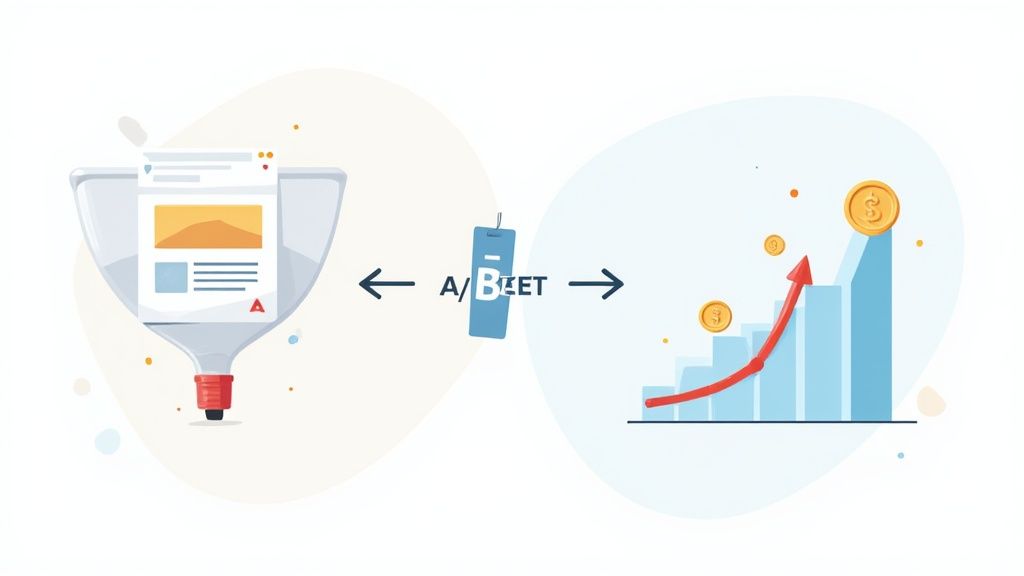
Conversion Rate Optimisation (CRO) is the process of improving your website to increase the percentage of visitors who complete a desired action, such as making a purchase. Instead of focusing on getting more traffic, CRO helps you get more value from the traffic you already have. For an ecommerce store, even a small increase in your conversion rate can lead to a significant boost in revenue, making it one of the most high-impact ecommerce marketing strategies available.
Why CRO is Essential for Ecommerce
Driving traffic to your site is only half the battle; if those visitors don't convert, your marketing spend is wasted. CRO directly impacts your bottom line by turning more browsers into buyers, increasing the return on investment from all your other marketing channels, like SEO and PPC. It’s about understanding user behaviour and methodically removing friction points that prevent a sale.
How to Implement Ecommerce CRO
A data-driven CRO strategy focuses on testing and refining key elements of the user journey:
- Analyse User Behaviour: Use tools like heatmaps (e.g., Hotjar) and analytics (Google Analytics) to understand how visitors interact with your site. Identify where they drop off in the buying process.
- Focus on High-Impact Pages: Start by optimising pages that have the biggest influence on sales, such as your homepage, product pages, and the checkout process.
- Formulate a Hypothesis and Test: Create a theory for improvement (e.g., "Changing the CTA button colour from blue to green will increase clicks"). Use A/B testing tools to test this on a segment of your traffic.
- Add Trust Signals: Build confidence by prominently displaying customer reviews, security badges (e.g., McAfee, Norton), and clear return policies.
Local Tip for Midlands Businesses: Offer a "Click and Collect" option for local customers in cities like Birmingham or Derby. Highlighting this at checkout can reduce cart abandonment for users who want to avoid delivery fees and get their items faster.
7. Customer Retention & Loyalty Programmes
Customer retention is the practice of encouraging existing customers to make repeat purchases, transforming one-time buyers into loyal, long-term patrons. This is often achieved through loyalty programmes, personalised communication, and exceptional service. As a core part of your ecommerce marketing strategies, retention is significantly more cost-effective than acquisition; it costs less to keep a customer than to find a new one.
Why Retention is Essential for Ecommerce
While attracting new customers is vital for growth, focusing on retention builds a stable, predictable revenue stream. Loyal customers tend to spend more over time and are more likely to become brand advocates, generating valuable word-of-mouth referrals. A good loyalty programme makes customers feel valued and less likely to switch to a competitor.
How to Implement a Retention Strategy
Building a successful customer loyalty programme requires a thoughtful approach that provides genuine value:
- Calculate Customer Lifetime Value (CLV): Before designing rewards, understand what a loyal customer is worth to your business. This will help you create a programme that is both generous and profitable.
- Design a Simple Programme: Use a points-based, tiered, or VIP system. Ensure the rules are easy to understand and the benefits are clear.
- Personalise Offers: Use customer data from your Shopify or WooCommerce store to send personalised offers. A customer who frequently buys a specific product might appreciate a discount on a related item.
- Communicate Consistently: Keep your programme top-of-mind through regular email updates, exclusive content, and early access to sales. Make customers feel like they are part of an exclusive club.
Local Tip for Midlands Businesses: Partner with another non-competing local business in Derby or Birmingham. Offer a joint loyalty benefit, such as a discount at their store for your loyal customers, to add unique value and strengthen community ties.
By investing in the customers you already have, you build a resilient business foundation that is less reliant on the fluctuating costs of new customer acquisition.
8. Referral & Affiliate Marketing
Referral and affiliate marketing are strategies that turn your existing customers and partners into a proactive sales force. Referral marketing incentivises happy customers to recommend your products to their network, while affiliate marketing involves paying a commission to external publishers for driving traffic and sales. Both leverage the power of trusted recommendations to acquire new customers in a cost-effective way.
Why Referral & Affiliate Marketing are Essential for Ecommerce
These strategies tap into one of the most powerful conversion drivers: social proof. A recommendation from a friend or a trusted blogger carries more weight than a traditional advertisement. This approach allows you to expand your reach, accessing new audiences through your advocates' networks. It's a performance-based model, meaning you only pay for actual results like a sale, making it a low-risk part of your ecommerce marketing strategies.
How to Implement Referral & Affiliate Marketing
Building a successful programme requires a clear structure and appealing incentives:
- Choose Your Programme Type: Decide if you want a customer-to-customer referral system (e.g., "Give £10, Get £10") or a more formal affiliate programme with bloggers and influencers.
- Offer Compelling Incentives: The reward must be valuable enough to motivate action. This could be a discount, store credit, a cash commission, or a free product.
- Automate Tracking & Rewards: Use tools like ReferralCandy or Tapfiliate to automate the process. These platforms generate unique links, track conversions, and handle reward distribution, saving you administrative effort.
- Equip Your Advocates: Provide your affiliates and referrers with marketing materials. This includes banners, pre-written social media posts, and product imagery to make sharing as easy as possible.
Local Tip for Midlands Businesses: Collaborate with Birmingham-based micro-influencers or local community groups on an affiliate basis. Their endorsement can drive highly relevant, local traffic and build authentic brand trust within the West Midlands market.
9. Retargeting & Remarketing Ads
Retargeting (or remarketing) is the practice of serving ads to users who have previously visited your website but left without making a purchase. By using tracking codes (pixels) to follow these potential customers across the internet and social media, you can display relevant ads that remind them of your products, encouraging them to return. It's one of the most effective ecommerce marketing strategies for converting "window shoppers" into buyers.
Why Retargeting is Essential for Ecommerce
On average, only a small percentage of website visitors convert on their first visit. Retargeting focuses on the rest, a pre-qualified audience already familiar with your brand. By re-engaging these warm leads, you significantly increase the chances of conversion and achieve a much higher return on ad spend (ROAS) compared to campaigns targeting cold audiences.
How to Implement Ecommerce Retargeting
A powerful retargeting campaign requires thoughtful segmentation and relevant messaging:
- Audience Segmentation: Don't treat all visitors the same. Create distinct audiences based on behaviour, such as users who viewed a specific product category, added an item to their cart, or visited your checkout page.
- Dynamic Product Ads: Use platforms like Facebook Ads or Google Ads to automatically show users the exact products they viewed on your site. This personalised approach is more effective than generic brand ads.
- Strategic Exclusions: To avoid wasting your budget and annoying customers, make sure to exclude recent purchasers from your campaigns.
- Frequency Capping: Limit the number of times a user sees your ad within a certain period. This prevents "ad fatigue" and ensures your brand doesn't come across as intrusive.
Local Tip for Midlands Businesses: If you have a physical store in places like Derby or Nottingham, use geotargeting in your retargeting ads. You could offer an exclusive in-store discount to local website visitors who abandoned their carts, bridging the gap between your online and offline sales channels.
10. Video Marketing & Live Shopping
Video marketing uses visual storytelling to demonstrate products, build connections, and drive customer engagement. For an ecommerce business, this means moving beyond static images to show your products in action, building trust and providing value. This approach includes everything from short-form TikToks and Instagram Reels to in-depth YouTube tutorials and interactive live shopping events. It's a vital part of modern ecommerce marketing strategies.
Why Video Marketing is Essential for Ecommerce
Video content significantly boosts engagement and conversion rates because it allows customers to see products from multiple angles and understand their benefits more clearly than text alone. It builds a deeper brand connection and can be repurposed across multiple platforms. Live shopping adds another layer, creating urgency and social proof through real-time interaction, allowing you to answer questions and drive sales instantly.
How to Implement Video Marketing & Live Shopping
A successful video strategy can be implemented without a Hollywood budget:
- Create Diverse Content: Produce short product demo videos, "how-to" guides, behind-the-scenes content, and customer testimonials.
- Optimise for Platforms: Tailor your content for each channel. Use vertical video for Instagram Reels and TikTok. Optimise YouTube video titles, descriptions, and thumbnails for search, and always include captions for accessibility and silent viewing.
- Embrace Live Shopping: Host live events on platforms like Instagram Live or Facebook Live during peak engagement times. You can showcase new arrivals, answer audience questions in real-time, and offer exclusive limited-time discounts.
- Showcase Products in Context: Demonstrate how your product solves a problem or fits into a customer's lifestyle. A makeup brand, for instance, can use YouTube tutorials to show application techniques.
Local Tip for Midlands Businesses: Team up with a Birmingham-based fashion or lifestyle vlogger to host a joint Instagram Live session. They can unbox and review your products for their local audience, providing authentic social proof and driving targeted traffic directly to your store.
By integrating video, you can transform passive browsers into active, engaged customers.
Top 10 Ecommerce Marketing Strategies Comparison
| Strategy | Implementation Complexity 🔄 | Resource Requirements & Speed ⚡ | Expected Outcomes 📊 | Ideal Use Cases 💡 | Key Advantages ⭐ |
|---|---|---|---|---|---|
| Search Engine Optimization (SEO) | High — technical audits, content & link building | Moderate ongoing resources; slow to show results (3–6 months) | Sustainable organic traffic growth; higher purchase intent 📊 | Long-term brand building; low-ad budgets; evergreen products | Cost-effective long-term ROI; credibility; compounding results ⭐⭐⭐⭐ |
| Email Marketing & List Building | Moderate — segmentation, automation setup | Low–Moderate effort; fast to convert once list grows ⚡ | High ROI; increased repeat purchases & retention 📊 | Repeat-buy businesses; launches; cart recovery | Direct owned channel; highly measurable; strong LTV lift ⭐⭐⭐⭐ |
| Pay-Per-Click (PPC) Advertising | Moderate–High — bidding, creatives, optimization | High spend potential; immediate traffic and measurable speed ⚡ | Immediate, scalable paid conversions; fast testing results 📊 | New products, competitive keyword capture, rapid growth | Fast targeted acquisition; precise control over spend and audience ⭐⭐⭐ |
| Social Media Marketing & Influencer Partnerships | Moderate — content production & community management | Variable (content + ad/influencer costs); medium-term impact | Brand awareness, engagement; indirect sales uplift 📊 | Visual/lifestyle brands; audience building; product discovery | Authentic reach via creators; UGC amplification; engagement ⭐⭐⭐ |
| Content Marketing & SEO Blogs | High — consistent high-quality content creation | Moderate–High ongoing effort; slow compounding results | Authority building; sustained organic traffic and referrals 📊 | Considered purchases; educational buying journeys | Thought leadership; multi-channel content assets; SEO support ⭐⭐⭐ |
| Conversion Rate Optimization (CRO) | Moderate — testing, analytics and iteration | Low–Moderate tools & analyst time; quicker wins with traffic ⚡ | Higher conversion rates; more revenue per visitor 📊 | Traffic-rich sites aiming to improve efficiency | Data-driven revenue gains; high ROI on existing traffic ⭐⭐⭐⭐ |
| Customer Retention & Loyalty Programs | Moderate — program design, personalization tech | Moderate continuous investment; medium-term payback | Higher CLV; predictable recurring revenue 📊 | Subscriptions, repeat-purchase businesses | Lower acquisition cost; improved margins and advocacy ⭐⭐⭐⭐ |
| Referral & Affiliate Marketing | Moderate — tracking, partner recruitment & support | Low variable cost (pay-per-result); scalable over time ⚡ | Cost-effective new customer acquisition; extended reach 📊 | Viral products; publisher-friendly niches | Pay-for-performance growth; leverages partner networks ⭐⭐⭐ |
| Retargeting & Remarketing Ads | Low–Moderate — pixel setup, audience segmentation | Moderate ad spend; fast conversion from warm audiences ⚡ | Improved recovery of lost visitors; higher conversion rates 📊 | Abandoned carts; short-funnel shoppers | Efficient conversion on warm traffic; dynamic product ads ⭐⭐⭐ |
| Video Marketing & Live Shopping | High — production, editing, live moderation | High resource/time investment; variable ROI timing | Increased engagement, conversions and brand recall 📊 | Demonstrable products; beauty/fashion; live events | Emotional storytelling; strong conversion uplift via demos ⭐⭐⭐ |
Putting It All Together: Your Next Steps
We’ve covered ten powerful ecommerce marketing strategies, from the foundation of SEO to the engagement of live shopping. The number of options can feel overwhelming, but the key is not to implement everything at once. Instead, the goal is to build a strategic marketing plan that works specifically for your business, your customers, and your budget.
Attempting to master SEO, PPC, content, and social media simultaneously can lead to burnout and diluted results. Sustainable growth lies in prioritising. Start by assessing your current position. If you are a brand-new Shopify store, foundational SEO and email list building are sensible first steps, creating long-term assets that will pay dividends for years. If you are an established WooCommerce business in Leicestershire with a steady stream of traffic, it may be time to focus on Conversion Rate Optimisation (CRO) to maximise every visitor, or to launch a targeted PPC campaign.
From Theory to Action: Building Your Marketing Plan
The most successful ecommerce brands don't just execute individual tactics; they create a system where each strategy supports the others. For example:
- Content & SEO: A high-value blog post (Content Marketing) attracts organic traffic through search engines (SEO).
- Traffic & Email: That same blog post includes a call-to-action to join your newsletter, converting traffic into subscribers (Email Marketing).
- Audience & Retargeting: You can then use that audience data to run efficient ads, showing specific products to people who have already shown interest (Remarketing).
- Sales & Loyalty: After a purchase, an automated email can encourage a review and offer a discount on their next order, turning a one-time buyer into a repeat customer (Customer Retention).
This interconnected system is more powerful than any single strategy in isolation. It transforms one-off campaigns into a self-sustaining cycle of customer acquisition and retention. The secret is to start small and build momentum. Select one or two of the ecommerce marketing strategies detailed in this guide that align with your immediate goals. Commit to implementing them properly, tracking the right KPIs, and giving them time to work.
Your Next Move: Measure, Adapt, and Grow
Ultimately, the most critical skill in digital marketing is adaptation. The online landscape is constantly evolving, and what works today might be less effective tomorrow. This is why measurement is so crucial. By consistently tracking your performance, you can understand what resonates with your audience, allowing you to double down on your successes and refine your approach over time.
Whether you're a local artisan in the Midlands looking to expand your reach or a professional services firm aiming for more qualified leads, the principles remain the same. Start with a solid foundation, build strategic connections between your marketing channels, and never stop testing and learning. This process of choosing a path, measuring results, and adapting your strategy is the engine of steady, profitable growth. You now have the blueprint; the next step is to start building.
Feeling uncertain about where to start or how to connect these strategies for your specific business? At Little Green Agency, we specialise in cutting through the noise and creating practical, results-driven marketing plans for SMEs in Leicester and across the Midlands. Let us help you identify the biggest opportunities for your business with a clear, jargon-free approach.

Leave a Reply