





Local SEO is the process of making your service business more visible in Google's local search results. It’s a targeted approach, designed to put you in front of potential customers in your specific area, right at the moment they’re searching for the services you provide.
Why UK Service Businesses Need Local SEO
The days of the Yellow Pages are long gone. Today, when someone needs a local service, their first move is to search on their phone. This is why local SEO for service businesses isn't just a marketing option—it's essential for bringing in new customers.
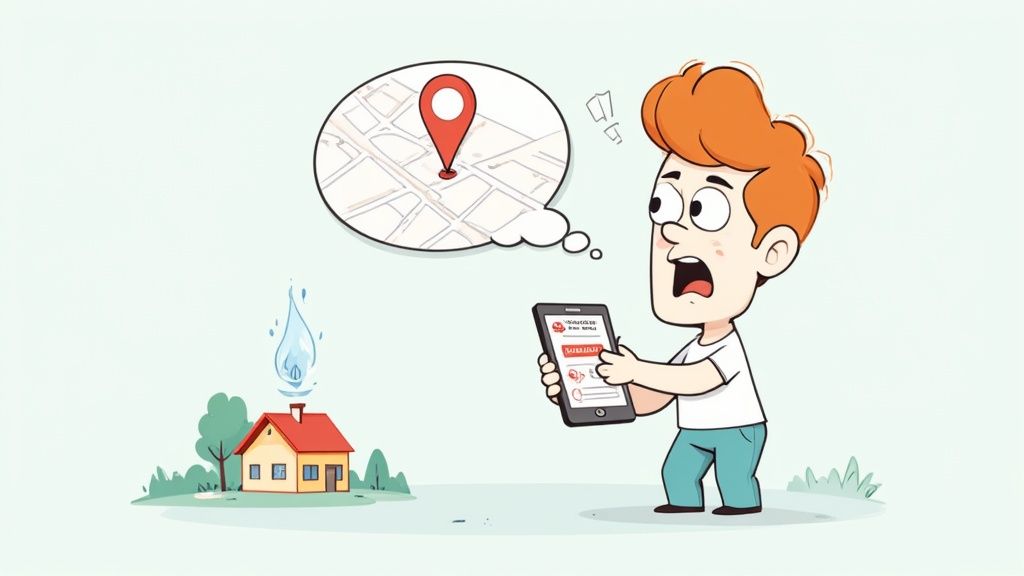
Imagine a homeowner in Leicester has a burst pipe. They will likely search for "emergency plumber Leicester". In that moment, Google provides a list of options. The businesses at the top, especially those in the 'Map Pack', are the ones that get the call.
That search result is your modern-day shopfront. Being visible in those critical moments is the difference between landing a valuable job and a potential customer not knowing you exist. If your business serves a specific local area, being found by local people is crucial.
The Customer Journey Starts Online
The journey from a customer having a problem to you providing the solution is now almost entirely digital. It's a straightforward process that your customers follow every day.
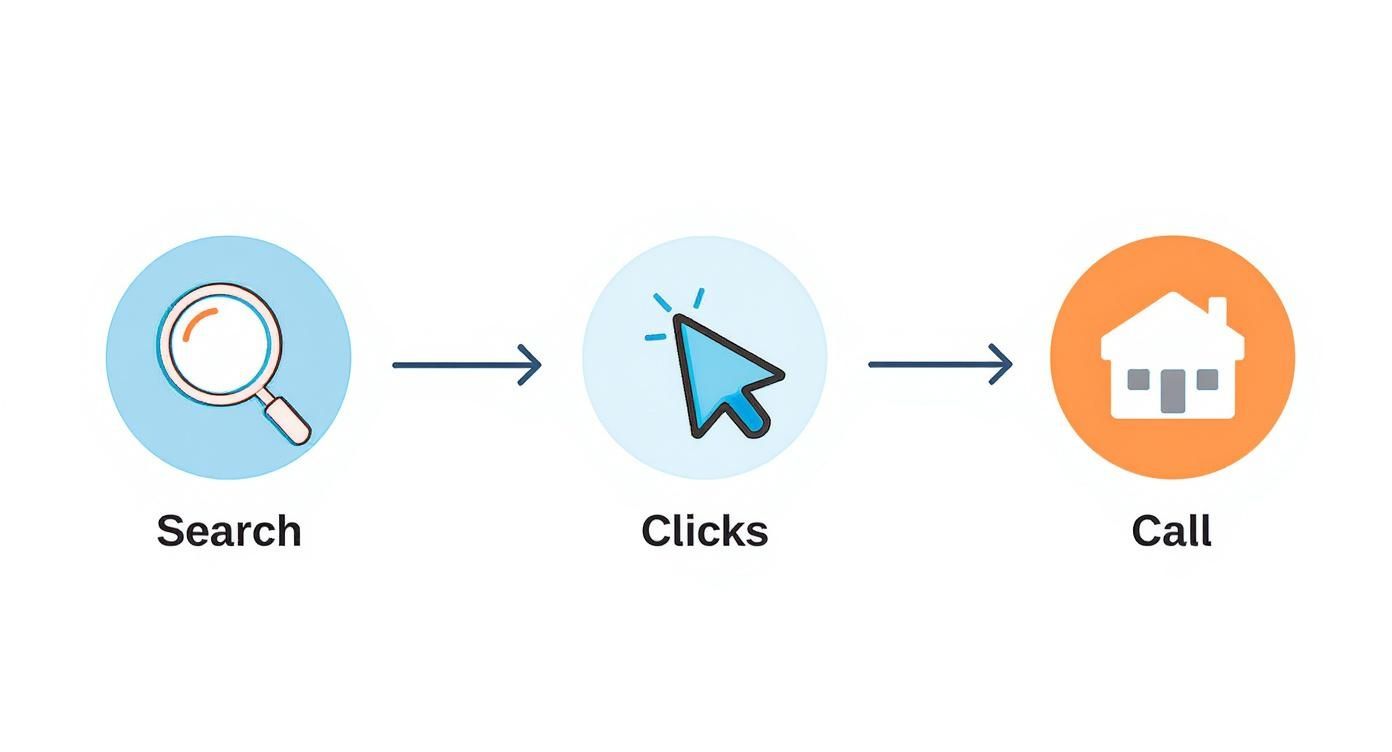
As you can see, if you’re not visible at the ‘search’ stage, you won’t get the ‘click’, and you certainly won’t get the ‘call’. You are effectively out of the running before the race has begun.
The Power of the Local Pack
The data supports this. Google holds the vast majority of the search market in the UK. When people make a local search, the ‘Local Pack’—the box with a map and three business listings—is where most of the activity happens. It receives an estimated 42% of all clicks.
Nearly half of all potential customers click on one of just three businesses.
Being in the Local Pack isn't just about being seen; it's about being chosen. It’s a powerful signal of trust and relevance to potential customers in your service area.
Ultimately, investing time in your local SEO connects your business to a healthier bottom line, driven by a consistent flow of local leads. It’s how you ensure that when someone in your community needs your skills, you’re the first name they see. For a deeper look into the fundamentals, you can learn more about what local SEO marketing involves in our detailed guide.
Mastering Your Google Business Profile
For any service business, your Google Business Profile (GBP) is your digital front door. It’s the map and info box that appears when someone locally searches for "plumber near me" or "electrician in Market Harborough." Getting this right is the cornerstone of local SEO.
Many business owners set up their profile and then forget about it. This is a missed opportunity. Your GBP is an active tool that needs regular attention to attract customers and show Google you're a prominent business in the local market.
Getting the Foundations Right
First, you must claim and verify your profile. This is non-negotiable. It proves to Google you’re the legitimate owner and unlocks all the optimisation tools. Once verified, the work begins.
The aim is to fill out every relevant section. An incomplete profile can appear unprofessional and is unlikely to perform well in search results.
Let's cover the basics:
- Business Name: Use your actual registered business name. Do not add keywords like "Leicester's Best Plumber"—this can lead to your listing being suspended.
- Business Categories: Be specific. Instead of "Tradesperson," choose "Plumber," "Electrician," or "Roofing Contractor." Your primary category should be your main service, then add secondary categories for other services you offer.
- Business Address: This is important for service businesses. If you travel to your customers (like a mobile mechanic or a landscape gardener), you should hide your home address and set your service areas. This is crucial for telling Google how you operate.
Why Your Service Area Matters So Much
For any business that works on-site with clients, this is one of the most important settings. Instead of a pin on the map at your office or home, you tell Google the exact postcodes, towns, or counties you cover.
Be realistic. If you're a gardener based in Loughborough, don't claim you serve the entire UK. Define your actual patch—perhaps a 15-mile radius, or list specific towns like Shepshed, Quorn, and Mountsorrel. This ensures Google shows your profile to people who can actually hire you.
Your GBP isn't just a listing; it's a direct communication with potential customers and Google's algorithm. The more complete, accurate, and active it is, the more likely you are to be featured when a local customer needs you.
Writing a Business Description That Works
You have 750 characters to tell your story. This is your chance to explain who you are, what you do, and why you’re a good choice for the job.
Think from a customer's perspective. What do they care about? Mention your years of experience, your commitment to quality, or your specialisms. For example, a Leicester-based electrician could write: "NICEIC-approved electrician serving Leicestershire for over 20 years. We specialise in domestic rewires, fuse box upgrades, and EICRs. Call for a no-obligation quote!" It's short, contains trust signals, and is to the point.
Bringing Your Profile to Life with Regular Activity
A 'set it and forget it' approach is ineffective. Consistent activity is what separates the businesses at the top of the map pack from the others. It’s a major signal to Google that your business is open, active, and relevant.
Industry research shows that GBP signals contribute to around 32% of local pack ranking factors. Businesses that keep their profiles updated with photos and posts can see up to 2.8 times more prominence in the map results. These Google Business Profile statistics show a clear link between engagement and visibility.
To help you get started, here's a checklist of the essential optimisation tasks.
Google Business Profile Optimisation Checklist
This table breaks down the key areas to focus on. Use it as a reference to ensure you've covered all the important bases.
| Optimisation Area | What to Do | Why It Matters |
|---|---|---|
| Core Information | Ensure Name, Address (or Service Area), and Phone (NAP) are 100% correct. | Consistency is the foundation of local SEO. Inaccuracies erode trust with both users and Google. |
| Business Categories | Select a specific primary category and add all relevant secondary categories. | This is how Google understands exactly what you do, matching you to relevant searches. |
| Service Areas | Define the specific postcodes, towns, or counties you serve. Hide your physical address. | Crucial for service businesses. It tells Google where your potential customers are located. |
| Business Description | Write a clear 750-character summary. Include keywords and unique selling points. | Your chance to make a good first impression and highlight what makes you the best choice. |
| Photos & Videos | Regularly upload high-quality images of your team, work, and van. Geotag if possible. | Builds trust and visually showcases the quality of your work. Fresh photos signal an active business. |
| Google Posts | Add a new post weekly to share offers, updates, or showcase recent projects. | Keeps your profile fresh and allows you to promote specific services directly in search results. |
| Reviews | Actively request reviews from happy customers and respond to all of them (good and bad). | Social proof is vital. Reviews heavily influence both customer decisions and your map ranking. |
| Q&A Section | Proactively add and answer frequently asked questions about your services. | Controls the narrative and provides quick, helpful information to potential customers. |
| Messaging Feature | Enable messaging and respond to enquiries promptly. | Offers a low-friction way for customers to contact you, improving lead generation. |
Making sure each of these areas is fully optimised and regularly maintained will put you ahead of many local competitors who neglect their profile.
Here’s a closer look at those ongoing tasks:
- Upload High-Quality Photos: Show, don’t just tell. Post clear pictures of your team, your branded van, your tools, and your finished work. A useful tip: enable location services on your phone when taking photos on-site. This can add valuable geotagging data to the image file.
- Get into the Habit of Google Posts: Think of these as free, local adverts. Use them to highlight a special offer ("10% off boiler servicing this month!"), showcase a completed project in Oadby, or link to a new blog post. They expire after seven days, so try to add a new one each week to keep things current.
- Turn on Messaging: This lets customers send you a quick message directly from your profile. It's an effective, low-effort way for potential clients to get in touch. The key is to respond quickly, as Google displays your average response time.
- Answer Questions (Even Your Own): The Q&A section is often overlooked. Pre-empt what customers will ask by adding your own questions and answering them yourself. Think: "Do you offer free quotes?" or "Are you fully insured?" This provides instant value and lets you control the information people see first.
Building a Website That Converts Local Searchers
Your Google Business Profile is effective at getting you found, but it's your website that helps secure the business. It's the bridge between a Google search and a paying client, turning visibility into actual business. To do its job, your site needs to clearly signal what you do and where you do it to both potential customers and Google.
For a local service business, a generic, one-page website is often not enough. To compete in local search, your website needs a structure that proves your expertise and pinpoints your service area. This means creating dedicated pages for each service you offer and every town you cover.
Creating Dedicated Service and Area Pages
Think of your website like an organised filing cabinet. Each service and each location needs its own clearly labelled drawer. This organisation helps Google understand your business with clarity, making it easier to rank you for specific, high-intent searches.
Let's take a roofer based in Leicester as an example. A basic website might have a homepage that says "roofing services". An optimised site would have separate, detailed pages for things like:
- Flat Roof Repairs: A page explaining the process, the materials you use, and why you’re the expert for this job.
- Gutter Cleaning Services: Another page explaining its importance, the signs of blocked gutters, and confirming the areas you cover.
- New Roof Installations: A page to showcase your best projects, discuss different tile options, and make it easy for someone to get a quote.
This structure tells Google, "This business is an authority on flat roofs, gutters, and new installations." You become a multi-faceted expert, not just a general roofer.
The same logic applies to location. If that Leicester roofer also serves Loughborough and Market Harborough, they need specific landing pages for those towns.
- Roofing Services in Loughborough: This page should feel local. Talk about common roofing problems in the area and feature testimonials from Loughborough customers.
- Emergency Roofer in Market Harborough: This page should be tailored to urgency, promising a fast response and making your contact details impossible to miss.
This hyper-local approach proves to Google you have a genuine presence in these places, increasing your chances of showing up when someone searches "roofer Loughborough."
A well-structured website with dedicated service and location pages is one of the most powerful signals you can send to Google about your local relevance. It moves you from being a generalist to a specialist in the eyes of the search engine.
Mastering On-Page SEO Essentials
Once your page structure is sorted, it’s time to fine-tune the content on each page. This is known as on-page SEO. It is about using the right words in the right places so Google and users know what each page is about.
The two most important places to get right are the Title Tag and the H1 Header.
- Title Tag: This is the blue, clickable link people see in Google's search results. It’s a key ranking signal.
- H1 Header: This is the main headline on the page itself. It should instantly reassure a visitor they've landed in the right place.
For a service page, a simple and effective formula is: Primary Service | Location | Brand Name. For example: Emergency Boiler Repairs | Leicester | ABC Plumbing.
For a location page, try this: Main Service in [Location] | Brand Name. For instance: Expert Electrician in Kibworth | Sparky & Co.
This isn't about stuffing keywords. It’s about creating clear, logical signposts that guide both people and search engine crawlers. A professionally built site will have these fundamentals in place from the start. If you're building your own, learning more about the principles of conversion-focused web design is a good starting point.
Explaining Your Business with Schema Markup
Finally, let's touch on a slightly more technical but powerful tool: Schema markup. You can think of it as a digital label for your business that you add to your website's code.
This code doesn't change how your website looks to a visitor. Instead, it speaks directly to search engines in their language, giving them structured information about your business.
What does Schema tell Google?
- Your official business name
- Your address and service area
- Your phone number
- Your opening hours
- The specific services you offer
By adding this 'digital label' to your website, you remove guesswork for Google. It helps confirm that the information on your site matches your Google Business Profile and other online listings, creating a consistent and trustworthy identity. That consistency is a cornerstone of building a strong foundation for local SEO.
Earning Trust with Reviews and Local Citations
When someone in Leicester needs a plumber or electrician, they search online. When they see a few local options, the one with positive reviews and a consistent, professional online footprint is the one that gets the call.
This section is about building that digital trust. This is the online equivalent of word-of-mouth, and it’s built on two pillars: customer reviews and local citations.
These signals tell both Google and potential customers that you're a real, active, and reputable business. Getting this right is fundamental to winning work in your local area.
Getting Your Story Straight with Citations
First, let's define citations. A citation is any online mention of your business's Name, Address, and Phone number (known as NAP). You’ll find them in online business directories, on social media, and on trade-specific websites.
The golden rule with citations is consistency. Your NAP details must be identical everywhere they appear. A slightly different business name on one site or an old phone number on another creates confusion for search engines. It makes them less confident about who you are and where you operate. This can negatively affect your local search rankings.
Think of Google as a detective. Every consistent citation is a piece of evidence backing up your story. Every inconsistency is a red flag.
For any local business, getting listed accurately on these key UK directories is a good place to start:
- Yell.com
- Thomson Local
- The Independent Business Directory (ibd-uk.org.uk)
- Your local Chamber of Commerce (e.g., Leicestershire Chamber of Commerce)
- Industry-specific sites (e.g., Checkatrade for trades, or a professional body)
Having consistent details on these platforms builds a bedrock of trust with search engines.
How to Ask for Reviews
While citations build credibility with Google, reviews build trust with people. A steady flow of recent, positive reviews is a powerful sales tool. However, you can't just wait for them to appear. You need a simple process to encourage them.
The best moment to ask is right after you've finished the job and the customer is happy with your work.
Here’s a simple workflow that works:
- Do a great job. This is non-negotiable. Good service is the only way to get good reviews.
- Mention it in person. As you’re finishing up, a casual mention can be effective. "We'd be grateful if you could spare a minute to leave us a review on Google. It really helps other local people find us."
- Follow up with a direct link. Later that day, send a quick text or email. Thank them again for their business and include the direct link to your Google review page. Making it simple is key.
A crucial piece of advice: never offer money or incentives for reviews. It is against Google's terms of service and can appear inauthentic to customers. The goal is to make it easy for genuinely happy people to share their experience.
The power of reviews is significant. Research shows that if a service business can increase its average rating from 3.5 to 3.7 stars—a tiny 0.2-star increase—its conversion rate can jump by almost 120%. Furthermore, businesses that reply to their reviews often see better results. You can see more stats on how reviews impact local business performance.
Why You Must Reply to Every Single Review
Getting reviews is only half the job. Replying to them—all of them—is where you can set yourself apart. It shows potential customers you're engaged and professional.
Responding to Positive Reviews (5 stars)
Always thank them by name and try to mention a specific detail about the job. It shows you remember them. For example: "Thanks so much, Sarah! It was a pleasure fitting those new spotlights in your kitchen. So glad you're happy with how they turned out."
Responding to Neutral Reviews (3 stars)
These often contain useful feedback. Acknowledge their point, thank them for their business, and show you're taking it on board. "Thank you for the feedback, Mark. We appreciate your business and will take your comments about our scheduling communication on board to improve."
Responding to Negative Reviews (1-2 stars)
This is the most important one. Do not get defensive.
- Start by apologising that their experience wasn't up to standard.
- Try to take the conversation offline. "I'm sorry to hear this. Please call me directly on [your number] so I can understand what happened and make it right."
- Keep your public response short, professional, and calm.
By handling all feedback gracefully, you send a powerful signal to future customers: you’re a responsible business owner who will step up to fix issues. That's a huge part of building trust and a cornerstone of effective local SEO for service businesses.
Building Authority with Local Links and PR
Once you have your Google Profile, website, and reviews in order, you have a solid foundation. This next part is where you can pull ahead of the local competition: building authority through local link building and digital PR.
In simple terms, it's about getting other reputable, local websites to link to you.
When another Leicestershire-based website links to yours, it's a powerful signal to Google. Think of it as a digital vote of confidence, telling the search engine you're a legitimate and respected part of the local business community. This is about building real-world relationships that translate into online credibility.
Practical Link Building Ideas for UK SMEs
Many business owners think "link building" sounds too technical. The truth is, some of the most effective strategies for a local service business are rooted in community engagement.
Here are a few achievable ideas that work for businesses here in Leicestershire:
Sponsor a local team or event: Get involved with a local kids' football club, a charity fun run, or a community fete. In exchange for your sponsorship, they will almost always add your logo and a link to your website on their 'sponsors' page. It's a genuine way to earn a highly relevant local link.
Partner with complementary trades: Who else serves your ideal customer? A plumber could team up with a tiler, or an electrician with a kitchen fitter. You can recommend each other's services and add a link to one another on a 'partners' page on your websites.
Offer a local discount: Approach a large local employer, like one of Leicester's universities or a major company. Offering a small, exclusive discount (e.g., 10% off for their staff) is often enough to get listed on their internal perks page, complete with a valuable link.
Tapping into Local Digital PR
Digital PR for a local business is about sharing what you know. You are an expert in your field, and local journalists and bloggers are always looking for knowledgeable sources to add credibility to their stories.
For instance, if the Leicester Mercury is running an online piece about getting homes ready for winter, a local roofer could offer a quote on checking for loose tiles. This gets your business name in front of a local audience and often earns you a link back to your website.
The best local links are a natural by-product of being an active, engaged, and helpful member of your local community. These are the authentic signals that Google is built to reward.
Showcasing Your Local Authority
As you build these local connections, make sure you show them off. It reinforces your credibility with potential customers who visit your site.
Create a simple "As Featured In" or "Community Partners" section on your homepage. Populating it with the logos of teams you sponsor or local publications that have mentioned you is a fantastic trust signal.
These strategies build genuine local relevance—the very thing Google wants to see when deciding who to rank for a search like "electrician near me." It shifts your website from being just an online brochure to being a recognised local authority. You can see examples of how we’ve helped businesses build this kind of authority by taking a look at some of our local SEO work.
Your Local SEO Questions Answered
Here are answers to some of the most common questions we hear from service business owners in Leicestershire. My goal is to clear up any doubts so you can move forward with confidence.
How Long Does Local SEO Take to Work?
The honest answer is, it depends. Local SEO is more like growing a garden than flicking a switch. You have to put in the work before you see the rewards.
For a new business starting from scratch, it can realistically take 6-12 months to build enough trust and authority with Google to start competing for valuable search terms.
However, if you've been in business for a while and just need to address the basics – like properly optimising your Google Business Profile and sorting out your citations – you could see improvements in the map pack in as little as 2-3 months. Consistency is key.
Do I Need a Physical Address to Rank Locally?
No. This is a common misconception, especially for mobile businesses like plumbers, electricians, or landscape gardeners who serve clients at their properties.
The key is how you set up your Google Business Profile. You'll need to use a real address for the verification postcard Google sends, but you then choose the option to hide it from the public. After that, you define your service areas by listing the specific towns, cities, or postcodes you cover. This tells Google where to show your business, so you can rank in Leicester or Loughborough without having a physical pin on the map.
What’s More Important: My Website or My Google Profile?
They are a team and need to work together.
Here’s how I explain it to our clients:
- Your Google Business Profile (GBP) is your digital billboard. It's what gets you noticed in the map results and gives people quick information: your phone number, opening hours, and reviews.
- Your website is your digital showroom. This is where potential customers come to be convinced. They'll browse your services, check out your portfolio, and get a feel for whether you're the right company for them.
You need both. Your GBP gets their attention, and your website closes the deal. If one is weak, your entire local marketing effort suffers.
A smart strategy for local SEO for service businesses means treating them as two parts of the same whole. When they're both optimised and reinforcing each other, you build a powerful, trustworthy presence.
Ready to improve your local ranking? The team at Little Green Agency has over 20 years of experience helping local businesses across Leicestershire get seen by the right customers. We offer transparent, no-jargon SEO that gets results. Start with a free, no-obligation audit of your website today. Find out how we can help at https://littlegreenagency.co.uk.
