


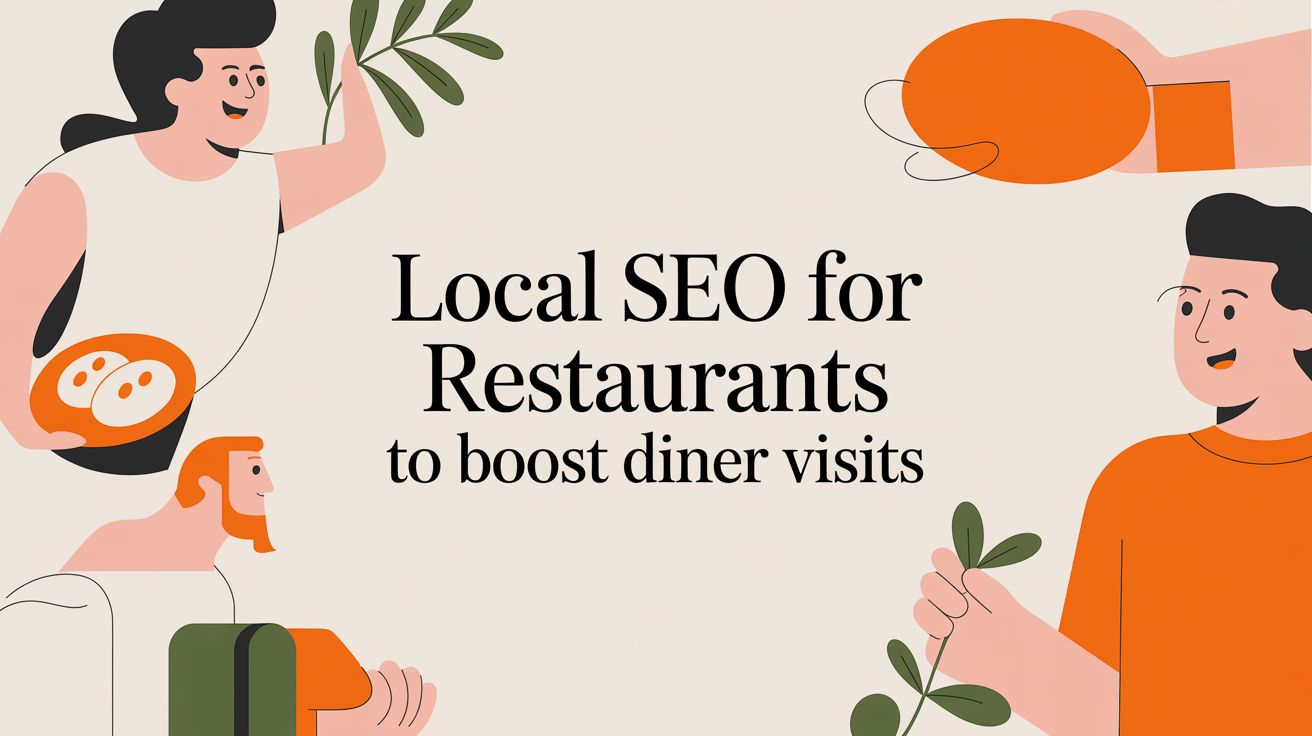

Local SEO is the process of making your restaurant more visible in local online search results. It helps you appear on Google Maps and in "near me" searches when potential customers are looking for somewhere to eat. Think of it as securing a prime spot on a digital high street, putting you directly in front of people actively searching for a meal.
Why Your Digital Front Door is Google
When was the last time you looked for a new place to eat? You likely used your phone and typed a search into Google.
Searches like "best Sunday lunch near me" or "Italian restaurant in Leicester" are now common. The days of using a phone book or wandering down the street are largely gone. This means your restaurant's most important location is no longer just its physical address—it's that top spot in Google's local search results.
For restaurant owners, this is a fundamental shift in how customers find you. Being visible at the moment a potential diner is hungry and searching can be the difference between a quiet Tuesday and a fully-booked service. It’s your digital front door, and local SEO is the key that opens it.
The Real-World Impact on Your Bottom Line
Effective local SEO does more than increase visibility; it directly impacts your revenue. When your restaurant appears in the top three local results—known as the "local pack"—you capture the attention of a large number of customers who are ready to decide where to eat.
The data supports this. In the UK, Google is a primary tool for discovering new places to eat, with research showing over a third of diners use it for that purpose. The impact of a high ranking is significant: businesses in the top three local Google search results receive 50% or more of all new customer clicks.
For an independent restaurant in Leicester, ranking in the top three for "best pizza in LE1" could lead to an extra 20-30 bookings each week. This isn't just extra income; it's the kind of growth that supports menu development, hiring more staff, and building a solid local reputation.
Here is a simple breakdown of how this translates into tangible results for your business.
The Real-World Impact of Local SEO on Your Restaurant
| Benefit | What It Means For Your Restaurant |
|---|---|
| Increased Footfall | More customers coming through the door, particularly from spontaneous "near me" searches on mobile phones. |
| Enhanced Credibility | A complete and professional online profile with positive reviews builds trust before a customer sees your menu. |
| Competitive Advantage | Every time you outrank a local competitor, you are capturing a customer they have missed. |
| Cost-Effective Marketing | Unlike a print advertisement, the benefits of local SEO compound over time, offering a better return on investment. |
Ultimately, a strong local SEO strategy ensures that when someone in your area is looking for a meal, your restaurant is the first and best answer they find. If you are new to this subject, our guide explains in more detail what is local SEO marketing and how the different elements work together.
Mastering Your Google Business Profile
If local search were a stage, your Google Business Profile (GBP) would be the main event. For most potential diners, it's the first thing they see about your restaurant when they search on Google or look you up on Maps. This free tool is the foundation of local SEO for restaurants, acting as a digital shop window that can either draw customers in or make them scroll to the next option.
Optimising your profile is essential. A well-managed profile does more than just list your address; it builds an accurate and inviting digital presence that can turn searchers into customers.
Getting the Basics Absolutely Right
First, it is crucial to get your core business information correct. It sounds simple, but this is where many businesses make mistakes, leading to customer confusion and a lower search ranking. We are referring to your NAP: Name, Address, and Phone number.
Consistency is vital. The details on your GBP must exactly match what is on your website, your Facebook page, and any other online directory where you are listed. Even a small inconsistency, such as using "St." on your profile but "Street" on your website, can create doubt for search engines and reduce the trust Google has in your data.
This image shows how direct the path from a search to your front door can be.
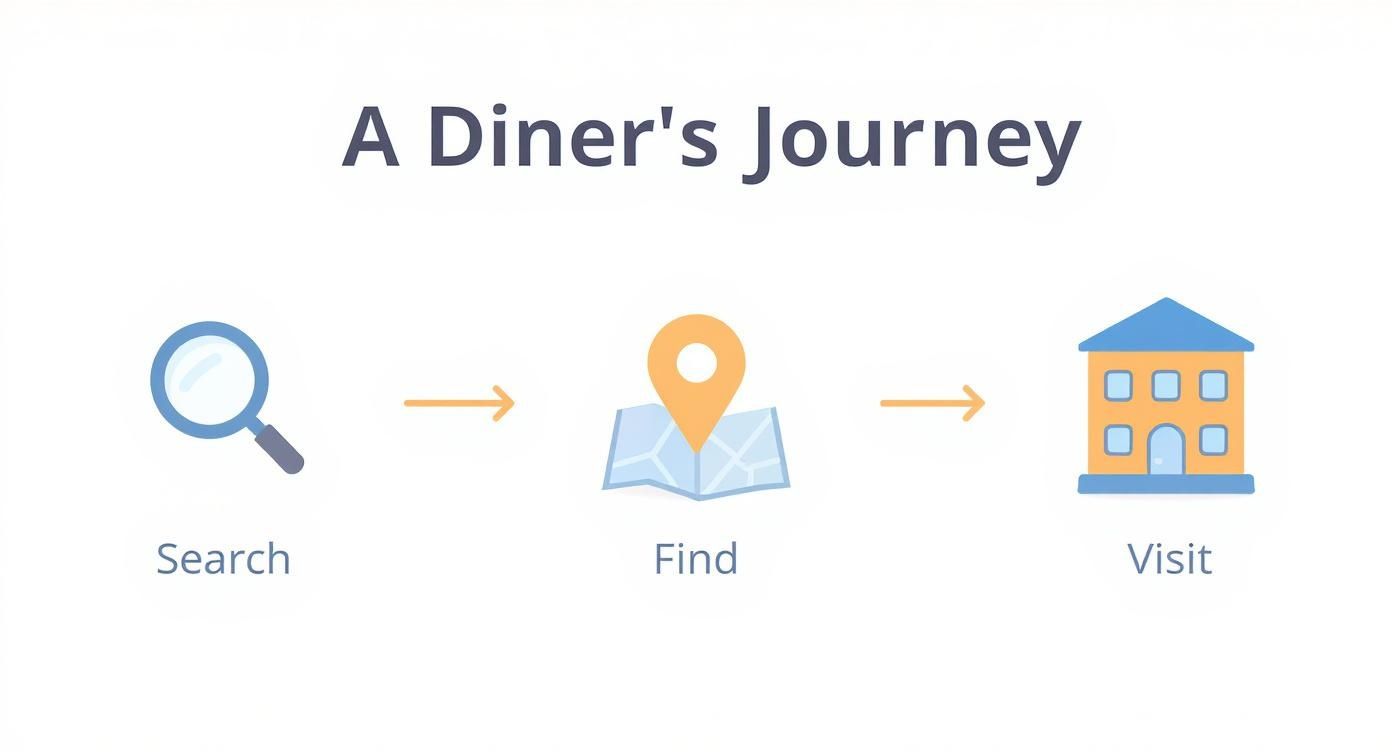
As you can see, the journey from a hungry searcher to a paying customer is often very short. This is why having an accurate and appealing profile is so important.
Choosing Your Categories Wisely
One of the most effective tools within your GBP is category selection. This is how you tell Google what your business does and for which searches it should appear. You will select one primary category and can then add several secondary ones.
Be specific. If you are a Leicester pizzeria that also serves pasta, your primary category should be ‘Pizzeria’, not the generic ‘Restaurant’. You can then add ‘Italian Restaurant’ and ‘Pasta Shop’ as secondary categories. This specificity helps you rank for high-intent searches like "best pizza in Leicester," which are more likely to lead to a booking.
Consider everything you offer:
- Have a cocktail bar? Add ‘Bar’.
- Offer takeaways? Use ‘Takeaway Restaurant’.
- Have a popular beer garden? There are categories for that, too.
The more precisely you define your business, the better Google can connect you with the right customers.
Bringing Your Restaurant to Life with Photos and Posts
People often decide where to eat based on visual appeal. Your GBP should be a visual showcase. According to Google's own data, businesses with photos get 42% more requests for directions on Google Maps and 35% more clicks through to their websites.
You should use a mix of high-quality, professional photos and more authentic, candid shots. Show your most popular dishes, the restaurant's interior, your staff, and a clear photo of the exterior so people can find you easily. You are helping potential diners imagine having a positive experience before they have even left their homes.
Beyond your photo gallery, Google Posts are a useful way to share timely news and offers. Think of them as free, small advertisements that appear on your profile when people search for you.
A good practice is to use Google Posts weekly. You can highlight a weekend special, announce a new menu item, promote an event, or share a positive customer review. These posts expire after seven days, making them ideal for creating timely interest and showing that your restaurant is active.
This consistent activity signals to Google that your profile is current and well-managed. This not only looks good to customers but also contributes directly to better local rankings. A complete, visually rich, and active profile is one of your most powerful marketing tools.
Building a Five-Star Online Reputation

In the restaurant industry, word-of-mouth has always been important. Today, these conversations happen online, making your review profiles on Google, TripAdvisor, and local directories crucial for your reputation. This is not just about making a good impression; it is a significant factor in how you rank in local search results.
From Google's perspective, a steady stream of recent, positive reviews indicates that you are a trusted, high-quality establishment worth recommending. Conversely, having no reviews—or a profile with unanswered complaints—can harm your visibility and deter potential customers.
Reviews have a strong influence on diners. A 2023 YouGov survey found that over 70% of UK diners read at least five online reviews before booking a table at a new restaurant. It is the digital equivalent of a personal recommendation. Getting this right pays off; businesses in Google's local three-pack see 126% more traffic and 93% more actions like calls and direction requests. To learn more, you can explore online reputation trends for restaurants in 2025 and see the impact on your business.
Encouraging Positive Customer Feedback
So, how do you get more positive reviews? It starts with providing a great experience, but even satisfied customers often need a prompt. The key is to make leaving a review as easy as possible.
You do not need a complicated system. From our experience, simple approaches are most effective:
- The personal touch: Train your staff to say something natural as customers leave, such as, "As a small local business, reviews really help us. If you enjoyed your meal, we would be grateful for a quick review on Google."
- A subtle visual cue: A small, well-designed card with the bill or a sticker on the door with a QR code can be very effective. Link it directly to your "Leave a Review" page on Google to remove any friction.
- The follow-up: If you take online bookings, a polite follow-up email the next day is a non-intrusive way to ask for feedback.
Remember never to offer incentives for reviews. This is against the terms of service for most platforms and undermines the trust you are trying to build. You want genuine feedback from genuinely happy customers.
The Art of Responding to Every Review
This step is essential. You must respond to your reviews—all of them. It shows potential customers that you are engaged, that you care, and that you take your reputation seriously. This applies to five-star reviews as much as it does to critical one-star comments.
Responding promptly and professionally to all reviews—good and bad—is one of the most powerful signals of trust you can send to both potential customers and search engines. It demonstrates that there's a real, caring person behind the business.
For positive reviews, a simple, personalised "thank you" is effective. Mention something specific from their comment, like the dish they enjoyed or the staff member who served them. This shows you have read it.
Negative reviews can be challenging, but they present an opportunity. The rule is simple: respond publicly with empathy and professionalism, then take the conversation offline to resolve the specifics. Never get into a public argument.
Turning Feedback into a Business Asset
Your reviews are more than just a score; they are a source of business intelligence. Positive reviews are excellent marketing material. Share snippets on your website or social media channels (with the reviewer’s permission) for powerful social proof.
And the negative feedback? That is free consultancy. If three reviews in one week mention that service was slow on a Saturday night or that a dish was under-seasoned, you have been given valuable, actionable insight. Use that criticism to identify weaknesses, retrain your team, or adjust your menu. By listening and making improvements, you are not just fixing a problem—you are creating a better experience that will naturally earn you more positive reviews in the future.
Turning Your Website into a Local SEO Powerhouse
While your Google Business Profile acts as the sign above your digital door, your website is the main dining room. It’s the one online space where you have complete control to tell your story, showcase your menu, and convince a potential diner that you are the right place to book.
Your website and Google profile work together. Google constantly cross-references your website to verify the details on your GBP. It crawls your pages to gain a deeper understanding of your food, your location, and why you are a good match for someone searching for a meal. A well-optimised website is a cornerstone of a solid local SEO plan.
Kicking Off with On-Page SEO Essentials
On-page SEO involves optimising the content and elements on your website pages. The goal is to make it clear to both search engines and users what each page is about. For a local restaurant, this means strategically including your town or city in your content where it feels natural.
Consider your page titles—the text in the browser tab and the main blue link in Google's search results. A generic "Sunday Lunch Menu" is adequate, but "Best Sunday Lunch in Leicester" is much more effective. It immediately signals your location and what you want to be known for.
Incorporate these location-based phrases into other key areas:
- Headings: Use clear, descriptive headings like "Our Dining Menu in Market Harborough" to structure your pages.
- Image Alt Text: When uploading a photo of a signature dish, describe it as "Our award-winning steak and ale pie, a local favourite in Leicestershire," not just "pie.jpg".
- Body Content: Write naturally about your local area, mention your local suppliers, and discuss your connection to the community.
Here is a quick checklist to help you stay on track.
On-Page SEO Checklist for Your Restaurant Website
| Element | Quick Tip | Why It's Important |
|---|---|---|
| Page Titles | Include your main keyword + location. e.g., "Authentic Italian Pizza in Leicester City Centre". | This is the strongest signal to Google about a page's topic and relevance for local search. |
| Meta Descriptions | Write a compelling 155-character summary that includes your location and a call to action. | This is your advertisement in the search results. A good one increases your click-through rate. |
| Headings (H1, H2) | Use your primary keyword in the H1. Use related terms in H2s. e.g., "Book a Table at Our Loughborough Restaurant". | Headings structure your content for readers and help search engines understand the page hierarchy. |
| Image Alt Text | Describe every image clearly, including location where relevant. e.g., "Our beer garden in Ashby-de-la-Zouch". | Helps with image search rankings and makes your site accessible for visually impaired users. |
| URL Structure | Keep URLs short and readable. e.g., /leicester-sunday-lunch-menu not /page-id-123. | Clean URLs are user-friendly and give search engines another clue about the page's content. |
| NAP Consistency | Ensure your Name, Address, and Phone number are identical on every page (usually in the footer). | Consistency across your site and the web builds trust with Google and prevents customer confusion. |
Addressing these basics is a significant step towards making your website more visible to local customers.
Making Technical SEO Simple with Schema Markup
"Technical SEO" can sound complicated, but one of its most powerful tools for restaurants is relatively straightforward to understand. It is called Schema markup.
Schema is a type of code you add to your website's backend. It does not change how your site looks to visitors, but it acts as a translator for search engines, helping them understand your content with greater clarity.
For a restaurant, this can be very beneficial. You can add specific Schema that tells Google things like:
- "This block of text is our full dinner menu."
- "These are our exact opening hours for this week."
- "This is our official address and phone number."
By providing Google with this information in a structured format, you improve your chances of earning 'rich results' in search. This is when Google shows star ratings, menu links, and opening times directly in the search results, making your listing more appealing.
Schema markup is like giving Google a neatly organised file of your restaurant's details instead of leaving it to sort through disorganized information. You make its job easier, and it can reward you with better visibility.
Why a Mobile-Friendly Site is Non-Negotiable
Most searches for local restaurants happen on a mobile phone. People are often out and about looking for "restaurants near me," or deciding at home where to book for the weekend.
If they click on your website and it is slow to load, the text is too small, or the booking button is difficult to use, they will leave very quickly.
This is not just about user experience; Google’s algorithm prioritises mobile-friendly websites. A site that functions well on a phone is no longer optional, it's essential. Our experience in web design for local businesses shows how critical a fast, responsive design is for converting visitors into customers. Your website must be quick, functional, and easy to use on a phone to perform well in local search.
Creating Content That Connects with Your Community
https://www.youtube.com/embed/wRaPWO8ItaE
Effective local SEO is about more than technical optimisation. It's about integrating your restaurant into your local community. When you create content that is relevant to your neighbours, you are not just trying to attract search engine traffic—you are building a loyal customer base and establishing your business as a local hub.
This is not about producing generic blog posts. The goal is to share stories and information that your customers in Leicester or the wider Midlands will find useful and interesting. This can help you rank for very specific local searches while building a real connection with the people you want to visit your restaurant.
Ideas for Hyper-Local Restaurant Content
Knowing what to write can be challenging, so here are a few practical ideas that have proven effective for restaurants.
- Spotlight Your Local Suppliers: Do you source vegetables from a farm near Melton Mowbray? Does a Leicestershire butcher supply your steaks? Write about them. It is a great way to highlight the quality of your ingredients while supporting another local business.
- Create a Guide to Local Events: Consider what is happening nearby. Are you close to the Curve Theatre or De Montfort Hall? Put together a simple guide like, "The Best Places for a Pre-Show Dinner in Leicester's Cultural Quarter." This can attract search traffic from people already planning a trip to your area.
- Introduce the People Behind the Plate: Conduct a short interview with your head chef or a long-serving member of your front-of-house team. Ask them about their favourite dish or what they like about the neighbourhood. This adds a human element that can make your restaurant more relatable.
This type of content is effective because it aligns with modern search behaviour. People are looking for immediate solutions. Searches for terms like 'near me today/tonight' have increased by over 900%. At the same time, searches that include 'open,' 'now,' and 'near me' have grown by more than 200%.
This data shows a clear trend: people are making spontaneous, last-minute decisions. Your hyper-local content can provide the exact answer they need. You can see more statistics on how local search habits are changing on embryo.com.
Getting Your Content Seen
Writing a good article is only half the task. You also need to get it in front of the right people. Sharing your posts strategically is what turns that effort into online engagement and, ultimately, more customers.
Your local content is a powerful tool for community building. When you share a story about a local supplier or event, you're not just doing SEO; you're starting a conversation and reinforcing your place within the community.
Once you publish a new blog post, the work is not finished. Think about where your local audience spends their time online.
- Local Social Media Groups: Find relevant Facebook groups for your town or community and share your content there. A post about your new vegan menu shared in a "Vegans of Leicester" group will be more impactful than a generic advertisement.
- Team Up with Local Influencers: Tag local food bloggers or community pages when you post on Instagram. A share from a trusted local voice can put your restaurant on the radar of hundreds of new potential diners.
- Don't Forget Your Email List: Your existing customers are your best advocates. Send your latest blog post to your email subscribers to encourage them to visit again.
Making a consistent effort to create and share community-focused content is what can distinguish your business from just another Google listing, helping it become a valued local establishment.
Common Questions About Local Restaurant SEO
Starting with local SEO can feel like learning a new recipe. It is normal to have questions, and with over 20 years in digital marketing, we have heard most of them. Here are some straightforward answers to the questions we hear most often from restaurant owners.
How Long Does It Take for Local SEO to Work?
This is a common question, and the honest answer is: it depends. Local SEO is not an instant fix like boosting a social media post; it is more like growing a garden. You have to prepare the soil, plant the seeds, and tend to them regularly.
You might see some early results within a few weeks. For example, once your Google Business Profile is fully completed, you could see an increase in profile views or requests for directions.
However, for more significant results—like appearing in the "local 3-pack" for a search such as "best Italian in Leicester"—it typically takes 3 to 6 months to build real momentum. The speed of your results will depend on factors like your local competition, the current state of your online presence, and how consistently you apply these efforts.
Think of it as a long-term investment in your restaurant's future. The groundwork you lay now will continue to bring diners through your doors for years, long after a paid ad campaign has ended.
Do I Really Need a Website, or Is Google Enough?
Your Google Business Profile is a powerful tool and can bring customers to you on its own. However, for a comprehensive strategy, your own website is essential. Think of your GBP as the sign outside your restaurant, and your website as the welcoming interior where people get the full experience.
Your website is the one digital space you own and control completely. It is your platform to:
- Showcase your restaurant’s unique personality.
- Display your full menu with high-quality photos.
- Tell your story and build a connection with your customers.
- Implement more advanced SEO tactics, like Schema markup and blogging.
Additionally, Google uses your website to cross-reference and learn more about your business. A solid, well-built website boosts your authority in Google's view, which in turn helps your Google Business Profile rank better. If some of these terms are new to you, our SEO glossary explains key concepts in plain English.
What Should I Focus On If I Have Limited Time?
We understand that restaurant owners are busy. If your time is limited and you can only focus on a couple of tasks, these are the areas that will provide the greatest return.
First, concentrate on your Google Business Profile (GBP). This is your most important online asset for local search. Ensure every detail is complete and 100% accurate—your name, address, phone number, website, and opening hours must be correct. Be specific with your categories as well.
Your second priority should be actively managing your online reviews. Make it a daily habit to check for new reviews and respond promptly. Thank people for positive feedback and handle any negative comments professionally and helpfully.
A well-optimised GBP combined with a strong, well-managed review profile will deliver the best results for the time you invest. These two elements are the core of local SEO for restaurants.
At Little Green Agency, we know the pressures local businesses are under. If you’re ready to get more covers booked without the guesswork, let’s have a chat. We deliver practical, results-driven SEO for restaurants across Leicester and the Midlands. Find out how we can help at https://littlegreenagency.co.uk.
