


For any small business, the term ‘affordable SEO services’ can be misleading. It isn’t about finding the cheapest deal, but about making a smart investment in activities that deliver a genuine return. It means focusing on the foundational work that brings local customers to your business, rather than chasing expensive strategies designed for large corporations.
What Affordable SEO Really Means for Your Small Business
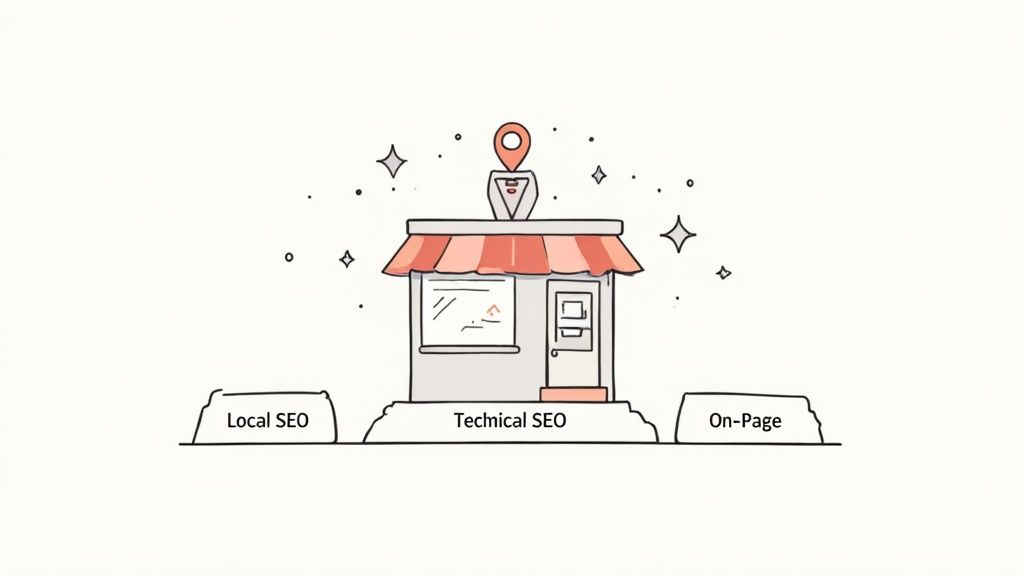
Think of it like building a house. You wouldn’t skip the foundations to save money. The same logic applies to your online presence. An affordable SEO strategy prioritises getting the essential, structural elements right before worrying about the decorative touches. It’s a strategic investment in your future, not just another monthly expense.
This approach focuses on what truly makes a difference for a local business. For example, a national retailer might spend thousands on a broad, country-wide campaign. But for a local bakery, more value comes from appearing first on Google Maps when someone nearby searches for “sourdough bread near me.” That’s the power of focused SEO.
The Focus on Value Over Volume
The measure of a good SEO plan is the value it generates, not its price. The goal should be to maximise your return on investment by concentrating on tasks that directly boost visibility, improve rankings, and drive customer enquiries. This is the opposite of low-quality “bulk” services that promise a lot but often do more harm than good.
A valuable, affordable SEO strategy is built on a few key principles:
- Targeted Actions: Focusing on high-impact areas like local search, on-page optimisation, and your website’s technical health.
- Sustainable Growth: Methodically building a solid online presence that delivers results for the long term, not relying on short-lived tricks.
- Measurable Results: Tracking progress through tangible metrics like an increase in website traffic, more phone calls, and higher rankings for local search terms.
For a small business, effective SEO is about being the best answer for a local customer’s problem. It isn’t about outspending competitors; it’s about outsmarting them with a focused, practical strategy that connects you with the people who need you.
Ultimately, a truly affordable SEO service empowers your business. It provides the tools and expertise to lay a strong foundation for long-term success, ensuring your budget is spent on activities that directly contribute to growth and attract more customers in your community.
What’s Actually In a Good SEO Package?
When you pay for an SEO package, you’re not just buying a vague promise of “more traffic.” You’re investing in a specific set of activities designed to put your business in front of the right people at the right time. An effective SEO service for a small business is built on three essential pillars that work together.
Think of it like getting a car roadworthy. You need a solid engine (technical health), a clear sat nav (on-page content), and to be listed on local maps so people can find you (local presence). If one of those is missing, you won’t get very far.
Foundational Technical SEO
Before attracting visitors, you must ensure your website is a place search engines like Google can easily understand. This is technical SEO – tidying up the back-end of your site to ensure it’s healthy, fast, and accessible.
It’s the digital equivalent of making sure your shop has clear aisles and no broken steps at the entrance. If search engine “crawlers” struggle to navigate your site, they are unlikely to recommend it to potential customers.
Key tasks in this area usually include:
- Improving Site Speed: Ensuring your pages load quickly. Slow sites frustrate users and are a negative signal for Google.
- Mobile-Friendliness: Making sure your website works perfectly on smartphones, where most local searches now happen.
- Fixing Errors: Finding and repairing broken links and other crawl errors that can confuse search engines.
- XML Sitemap: Creating a “map” of your website that helps Google find and index all your important pages.
Strategic On-Page SEO
Once your website’s foundation is solid, the next step is to work on the content people see. This is on-page SEO, and it’s about making your pages highly relevant to what your potential customers are searching for.
This part of the process focuses on aligning your page titles, headings, and body text with the specific phrases your audience uses. For example, a plumber in Leicester would want their services page to be optimised for terms like “emergency plumber Leicester” or “boiler repair Kibworth.” It’s a common-sense approach.
A good, affordable SEO package will always include optimising these elements to signal relevance to both users and search engines. You can get into the details by reading our complete on-page SEO checklist, which breaks down the most important factors.
A well-optimised page does more than just rank; it speaks directly to the customer’s needs, answers their questions, and encourages them to take action, whether that’s making a call or filling out a form.
Powerful Local SEO
For most small businesses, this is the most important pillar. Local SEO is focused on making your business prominent in location-specific searches, especially on Google Maps and in the “map pack” that appears at the top of the results.
This is where you connect directly with customers in your service area. It involves managing and optimising your Google Business Profile, making sure your business name, address, and phone number are consistent online, and encouraging customer reviews.
The power of this focused approach is significant. Data shows that local search results are dominated by a mix of business websites (around 47% of first-page results), directories (31%), and business mentions (16%). This means that targeted local optimisation can give small firms major visibility gains. You can explore these findings and learn more about local SEO statistics on BrightLocal.
By combining these three core components—a healthy technical foundation, relevant on-page content, and a strong local presence—an affordable SEO package builds an online presence that generates genuine leads.
Understanding SEO Pricing and Realistic Budgets
Setting a budget for SEO can feel like guesswork. With agencies and freelancers quoting a wide range of prices, it’s hard to know what’s fair and what you’ll get for your money. It helps to think of it like any other professional service: the price reflects the time and expertise being invested into growing your business.
By understanding how agencies structure their fees and what’s typically included at different price points, you can make an informed decision for your business.
Common SEO Pricing Models Explained
Most providers use one of two main pricing models. Each has its benefits, and the best fit will depend on your specific goals.
- Monthly Retainer: This is the most common setup. You pay a set fee each month for ongoing services like content creation, technical checks, and local SEO management. The benefit of a retainer is consistency. It allows an SEO partner to build momentum, learn what works for your audience, and adapt the strategy over time for sustainable growth.
- Project-Based Fee: This is a one-off payment for a specific, defined task, such as a complete technical SEO audit or setting up your local search presence from scratch. It’s a good option if you have a clear, immediate problem to solve and a fixed budget, but it doesn’t offer the ongoing strategic support of a retainer.
For most small businesses, a modest but consistent monthly retainer usually delivers the best long-term results. SEO is a marathon, not a sprint, and steady, sustained effort will beat a short burst of activity.
What Does a Realistic SEO Budget Look Like in the UK?
SEO costs can vary depending on the amount of work needed and how competitive your industry is. But knowing the typical price bands helps you set realistic expectations.
In the UK, monthly retainers for small businesses often fall between £300 and £1,500 per month. As a business grows, you might see more comprehensive plans ranging from £800 to £3,000. Large national campaigns can easily go beyond £5,000 a month.
A piece of advice for business owners: the cheapest option is almost never the best value. Rock-bottom prices often mean corners are being cut on essentials like content quality or technical diligence, which can end up harming your website.
A good, affordable SEO service will balance its efforts across three core pillars.
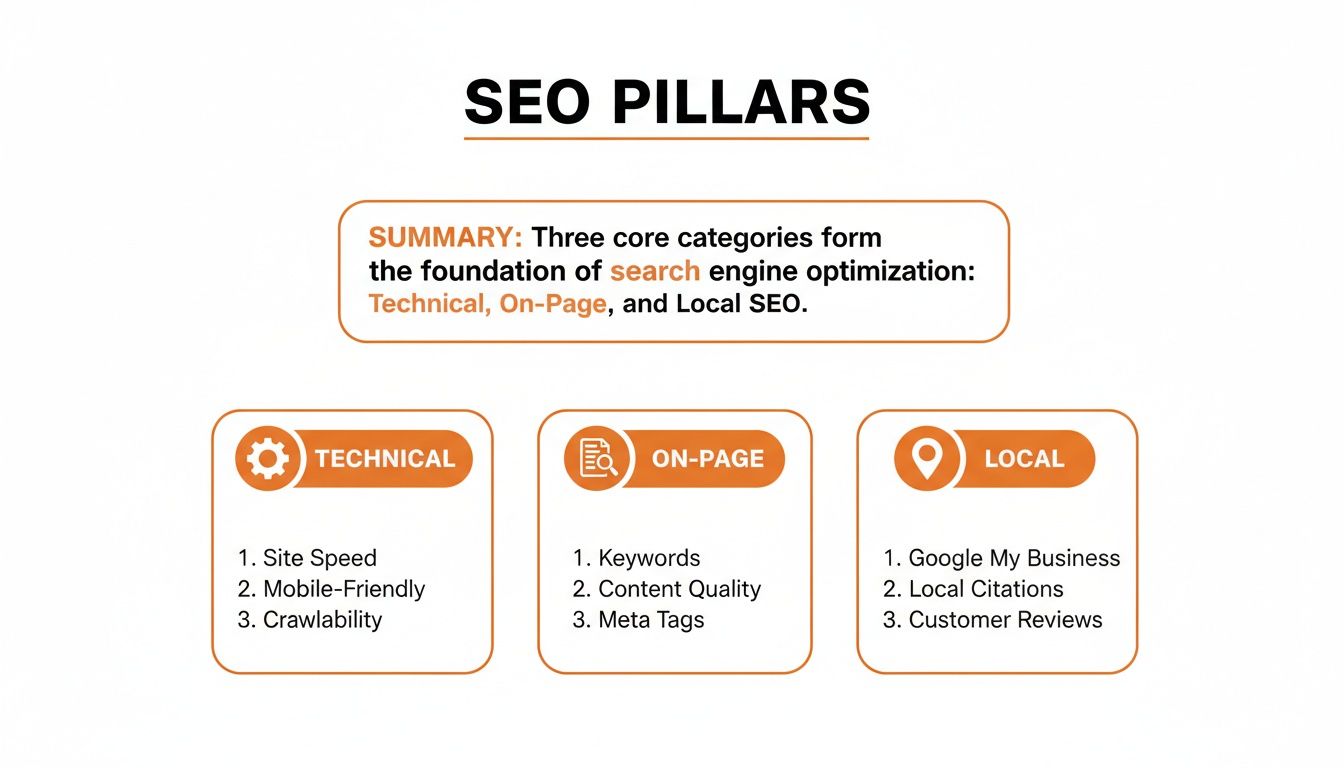
This shows how a smart budget should be spread across keeping your site technically sound, ensuring your on-page content is effective, and making sure you’re visible in local searches.
Matching Your Budget to Real-World Services
This table breaks down what you can typically expect at different monthly investment levels.
Typical UK SEO Package Costs and Inclusions
This table shows common monthly SEO packages available to UK small businesses and what services are generally included at each price point.
| Package Tier | Typical Monthly Cost (UK) | Core Services Included | Best For |
|---|---|---|---|
| Starter / Foundation | £300 – £600 | Google Business Profile management, basic technical monitoring, local citation management, monthly performance report. | Local businesses, sole traders, or startups just getting started with SEO and focusing on foundational visibility. |
| Growth / Standard | £600 – £1,500 | All starter services, plus on-page optimisation for key pages, new blog content or landing page creation, basic link building. | Small businesses in moderately competitive markets looking to actively grow their organic traffic and leads. |
| Pro / Advanced | £1,500 – £3,000+ | All growth services, plus a more robust content strategy, advanced technical SEO fixes, proactive link building outreach, competitor analysis. | Established SMEs aiming for significant market share, e-commerce stores, or businesses in highly competitive industries. |
As you can see, a budget at the lower end of the scale (around £300-£600 per month) gets the fundamentals right. This is about building a solid foundation.
This usually covers:
- Google Business Profile Management: Keeping your listing optimised and active.
- Basic Technical Monitoring: Catching critical website errors before they cause problems.
- Local Citation Management: Ensuring your business name, address, and phone number are correct online.
- Monthly Performance Reporting: A simple report tracking key numbers like local rankings and website visitors.
As you invest more, the service becomes more proactive. A mid-range budget allows for creating new content, improving existing pages to rank higher, and building your authority in your local area. The key is to find a package that lines up with your business goals without overstretching your budget.
How to Measure SEO Success and Your Return on Investment
Investing in SEO can feel like a leap of faith if you’re not sure how to track what’s happening. But good SEO is measurable, tying your investment directly to business results.
You don’t need to be a data expert to know if your money is working for you. The key is to stop looking at “vanity metrics” – like a random spike in website visits – and start focusing on the Key Performance Indicators (KPIs) that actually grow your business.
Focusing on Meaningful KPIs
For any small business, a successful SEO campaign isn’t just about getting more traffic. It’s about getting the right traffic from people looking for what you offer. This means tracking progress that directly impacts your bottom line.
So, how do you know your investment in affordable seo services for small business is paying off? Keep an eye on these core KPIs:
- Growth in Organic Traffic: A steady rise in visitors finding you through search engines is a clear sign that things are moving in the right direction.
- Improved Keyword Rankings: Are you climbing in Google for your most important local searches? Tracking your position for terms like “electrician in Market Harborough” is vital.
- Increase in Conversions: A conversion is any valuable action someone takes on your site, like making a phone call or filling out a contact form. These are real leads.
Ultimately, measuring success boils down to one question: “Is my online presence generating more business than it did before?” If organic traffic is up and your phone is ringing more, you have your answer.
Essential Tools for Tracking Your Progress
You don’t need expensive software to see what’s going on. Two free tools from Google give you everything you need to see the results of your SEO efforts.
Google Search Console
Think of Google Search Console as your direct line to Google. It’s a free tool that shows you how your website is performing in search results.
It provides data, including:
- Queries: The actual search terms people are using to find you.
- Impressions: How many times your site has appeared in search results.
- Clicks: How many people clicked through to visit your website.
- Average Position: Your site’s average rank for different keywords.
This information helps you understand what’s working, spot new opportunities, and get alerts about technical issues.
Google Analytics
While Search Console tells you how people find your site, Google Analytics tells you what they do when they get there. It’s the key to understanding your visitors and measuring conversions.
With Google Analytics, you can get answers to questions like:
- Which pages are the most popular?
- How long are people staying on my site?
- Where are my visitors coming from?
- Which channels are bringing in the most leads?
Understanding these metrics is important, but remember that SEO results don’t appear overnight. To set realistic expectations, it’s worth taking a moment to learn more about how long SEO can take to show results in our guide. Patience, combined with consistent tracking, is the way to see a return on your investment.
How to Spot the Bad Apples When Choosing an SEO Provider

Choosing an SEO partner is a significant decision. The industry has some providers who take advantage of the demand for affordable SEO with offers that sound too good to be true.
Picking the wrong agency doesn’t just waste your money; it can harm your website’s standing with Google, and recovery can take months, if not years.
The good news is that many of these providers use the same predictable tactics. Once you know what to look for, the red flags become obvious. This is your best defence in finding a credible partner who understands what it’s like to run a small business.
Red Flag 1: “We Guarantee #1 Rankings”
This is the biggest red flag. No one can honestly guarantee a #1 spot on Google. Google’s algorithm is complex and constantly changing, with hundreds of ranking factors.
A trustworthy expert will talk about improving visibility, targeting the right keywords, and growing your organic traffic. These are realistic, measurable goals that deliver real value.
Red Flag 2: “You’ll See Results Overnight”
SEO is a long-term investment that builds momentum over time. It involves methodically improving your site’s technical health, creating valuable content, and building authority. Seeing tangible results typically takes three to six months, and sometimes longer in a competitive market.
Any provider promising instant success is likely using risky, short-term tactics that can lead to a Google penalty. These “black-hat” methods might provide a brief increase in traffic, but the subsequent drop can leave you in a worse position. A proper digital marketing agency for a small business will be upfront about realistic timelines.
A genuine SEO strategy is like planting a tree, not flipping a switch. It requires patience and consistent effort to grow strong roots that will support your business for years. Quick fixes often lead to long-term problems.
Red Flag 3: A Lack of Transparency
A good SEO partner should be an open book. They should be able to explain what they’re doing in plain English, without hiding behind jargon or “proprietary secrets.” If a potential provider is vague about what they’ll do for you each month, you should be cautious.
Don’t be afraid to ask direct questions. What does their link-building process involve? How do they decide what content to create? If their answers are evasive, it’s a warning sign. You have a right to know what your money is paying for.
Here’s a quick-reference checklist to help you evaluate a potential SEO provider.
SEO Provider Checklist: Good Signs vs Red Flags
| Area of Evaluation | Green Flag (Good Sign) | Red Flag (Warning Sign) |
|---|---|---|
| Promises & Guarantees | Focuses on improving key metrics like traffic, leads, and visibility. Sets realistic goals. | Guarantees specific rankings (e.g., “#1 on Google”). Promises instant results. |
| Transparency & Communication | Clearly explains their strategy and methods. Provides regular, detailed reports. | Hides behind “secret sauce” or proprietary techniques. Vague about their process. |
| Strategy & Tactics | Talks about a balanced approach: technical SEO, quality content, and ethical link-building. | Heavily pushes cheap link packages or tactics that sound too easy or automated. |
| Case Studies & Reviews | Shares relevant case studies with real data and has verifiable client testimonials. | Lacks credible examples or has generic, unconvincing testimonials. |
| Contract & Pricing | Offers clear, itemised pricing and fair contract terms. Explains what’s included. | Pushes long, inescapable contracts. Has hidden fees or unclear pricing structures. |
Keep this checklist handy. It will help you find a partner who is genuinely invested in helping your business grow the right way.
So, What’s Next on Your SEO Journey?
Understanding SEO can feel like a big task, but finding a path that works for your budget is achievable for any small business. The main point is this: smart SEO isn’t about having the deepest pockets. It’s about making focused choices that make a difference.
Good SEO starts with a solid foundation. That means getting the technical aspects of your website right, creating content that your local customers are looking for, and ensuring your business shows up correctly on places like Google Maps. It’s about value, not just cost.
The Big Ideas to Take Away
As you decide what to do next, keep these key points in mind. They’ll help you avoid wasting time and money and put you on the path to seeing a real return.
- Stick to High-Impact Activities: Put your energy into local SEO, on-page improvements, and your site’s technical health. These are the things that build steady, long-term growth.
- Measure the Right Things: Keep an eye on the results that matter: more organic traffic, better rankings for local searches, and more phone calls and enquiries.
- Watch Out for Red Flags: Be cautious of anyone guaranteeing a #1 spot or promising instant results. A good partner is honest, realistic, and focused on your business goals.
Think of affordable SEO as a silent sales engine. It should be working in the background, consistently bringing the right people to your digital doorstep without you having to pay for every click.
A No-Pressure First Step
The most logical place to start is to understand your current position. You wouldn’t set off on a road trip without a map. Getting a clear picture of your website’s strengths and weaknesses helps you decide where to invest your time and money.
This first step doesn’t have to be a huge commitment. With over 20 years of digital marketing experience helping small businesses, we know how important it is to make practical, effective choices. That’s why we offer a complimentary, no-obligation SEO audit. It’s designed to give you a clear, jargon-free snapshot of your current situation.
Our audit will show you where your biggest opportunities are, pointing out the quick wins and essential fixes that can make a difference. It’s a simple way to see your business’s potential and understand how a focused strategy can connect you with more customers.
Ready to see how affordable, effective SEO can work for you? Book your free SEO audit with Little Green Agency today. Let’s start building a practical plan for your growth.
Got Questions About SEO? We’ve Got Answers
Stepping into the world of SEO can feel like learning a new language. It’s normal to have questions. Here are a few of the most common ones we hear from small business owners, answered in plain English.
How Long Until I Actually See Results From SEO?
The honest answer is that SEO is a marathon, not a sprint. While you might see a small boost from fixing a technical issue, lasting results don’t happen overnight.
You can typically expect to see meaningful movement—like a climb in your keyword rankings and a steady increase in organic traffic—within three to six months. This gives us enough time to do the foundational work properly: optimising your site, creating content, and earning trust from search engines.
Think of SEO like planting a garden. You wouldn’t expect a full harvest the day after you sow the seeds. It needs consistent care and patience to grow strong roots that will support your business for years to come.
Can’t I Just Do My Own SEO?
You absolutely can. Many business owners start by managing their own Google Business Profile or tweaking the text on their web pages. If you’ve got the time and a desire to learn, it’s a great way to begin.
However, DIY SEO has its limits. The field is complex and always changing, and tackling deeper technical problems or building a competitive content strategy benefits from an expert eye. It comes down to a trade-off: time versus money. Doing it yourself saves you cash up front, but a professional can often get you better results, faster, while helping you avoid common pitfalls.
Is Local SEO All My Business Really Needs?
If your business serves a local community—like a café, a garage, or a high-street solicitor—then local SEO is fundamental. It’s what gets you in front of people searching for services “near me,” driving phone calls and customers to your door.
But it’s rarely the only piece of the puzzle. Your local visibility needs a solid foundation. That means having a website that works well on mobile phones (technical SEO) and is filled with helpful content that answers your customers’ questions (on-page SEO). Imagine ranking number one on Google Maps, but when someone clicks through, your website is slow and difficult to use. A balanced strategy ensures that when people find you, they have a good experience that turns them into a customer.
At Little Green Agency, we’re here to build that balanced, effective strategy that fits your goals—no jargon, no bluster, just practical actions that deliver real growth.
Curious to see where your website stands? Request a quote for our Leicester SEO services.

Leave a Reply